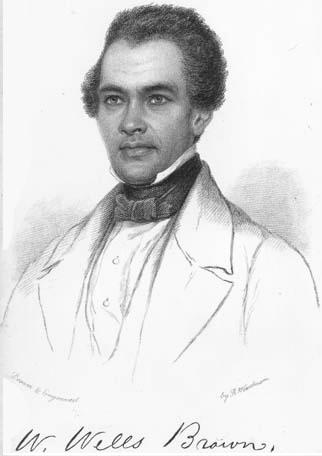
William Wells Brown
1814 — 1884 · First African American novelist; first African American playwright
William Wells Brown was born into slavery near Lexington, Kentucky, in March 1814, the son of an enslaved woman and her white master George W. Higgins. He was hired out as a steamboat hand on the Mississippi River through his teenage years, escaped to free territory in 1834 at the age of approximately twenty, and took the name Wells Brown from the Quaker abolitionist who sheltered him in his first hours of freedom.
He produced, over the next four decades, the founding works of African American literary fiction. Narrative of William W. Brown, a Fugitive Slave (1847) was the second-most-widely-read American slave narrative of the antebellum period after Frederick Douglass's. Clotel; or, The President's Daughter (1853) — an examination of slavery framed around the figure of an enslaved daughter of Thomas Jefferson — was the first novel published in the English language by an African American. The Escape; or, A Leap for Freedom (1858) was the first play published by an African American. The Black Man, His Antecedents, His Genius, and His Achievements (1863) was the first published collective biography of African Americans by an African American.
He was a sustained presence on the abolitionist lecture circuit through the 1850s, traveled to England in 1849 and lectured there for five years, and qualified as a medical doctor in Boston in 1864 — practicing medicine alongside his literary work for the remainder of his life.
He died in Chelsea, Massachusetts, on the sixth of November 1884, age seventy.
He is honored here as the first African American novelist, the first African American playwright, and the first African American to publish a collective biography of his people.
Curated with honor.
⚙ Permanence proof
This entry is pinned to the InterPlanetary File System (IPFS) by our own node so that a copy survives independent of any single web host. Anyone with the content identifier below can fetch a verifiable snapshot from any public IPFS gateway — now and decades from now.
To verify independently, paste the CID into any public IPFS gateway (dweb.link, ipfs.io, cf-ipfs.com) — or run your own IPFS node and request the CID directly.
Placed in the archive by the Honored Ancestors editorial team.