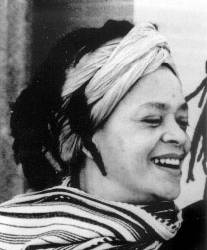
Toni Cade Bambara
1939 — 1995 · Novelist, short-story writer, and film-maker; editor of The Black Woman; author of The Salt Eaters and the 1986 documentary Bombing of Osage Avenue
Miltona Mirkin Cade was born on the twenty-fifth of March 1939 at Harlem, New York, the daughter of Walter Cade and Helen Brent Henderson Cade. Her parents named her after the white New York philanthropist Milton Mirkin, who had supported the Cade household through the Depression. She objected from her early adolescence to the name, signed her schoolwork from the sixth grade as Toni Cade, and added the surname Bambara — from the West African Mande ethnic group of present-day Mali, whose name she had encountered in a family album of her great-grandmother's signatures — at twenty-six in 1970.
She was educated at Queens College of the City University of New York, completing the bachelor's in 1959, and at the City College of New York, completing the master's in 1964. She worked through her twenties as a social investigator for the New York State Department of Welfare and as a programme officer for the Antipoverty Programme of the City of New York. She joined the English faculty of City College in 1965 and remained there until 1969, leaving for Livingston College of Rutgers University, where she taught from 1969 to 1974. She moved to Atlanta in 1974 with her daughter Karma Bene Bambara.
She edited in 1970 the anthology The Black Woman — the first published collection of writing by Black women as a discrete cultural formation rather than as members of a larger Black or feminist canon. The anthology contained the early work of Audre Lorde (placed in this archive), Nikki Giovanni, Alice Walker, and Paule Marshall and is generally identified as the founding documentary collection of Black feminist literature. She published her first short-story collection — Gorilla, My Love — in 1972 and her second — The Sea Birds Are Still Alive — in 1977.
Her decisive long-form novel — The Salt Eaters of 1980 — received the American Book Award the same year. She turned thereafter to film-making, producing in 1986 the hour-long documentary The Bombing of Osage Avenue on the police destruction of the MOVE house in Philadelphia in May 1985, and in 1994 the second-feature documentary W. E. B. Du Bois: A Biography in Four Voices, broadcast by PBS in 1995.
She died of colon cancer at Philadelphia on the ninth of December 1995, at fifty-six.
She is honored here as the editor of The Black Woman.
Curated with honor.
⚙ Permanence proof
This entry is pinned to the InterPlanetary File System (IPFS) by our own node so that a copy survives independent of any single web host. Anyone with the content identifier below can fetch a verifiable snapshot from any public IPFS gateway — now and decades from now.
To verify independently, paste the CID into any public IPFS gateway (dweb.link, ipfs.io, cf-ipfs.com) — or run your own IPFS node and request the CID directly.
Placed in the archive by the Honored Ancestors editorial team.