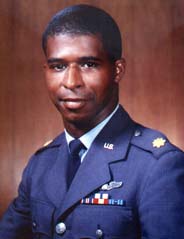
Robert Henry Lawrence Jr.
1935 — 1967 · United States Air Force test pilot; first African American astronaut selected to a US human-spaceflight programme; killed in training before flight
Robert Henry Lawrence Jr. was born on the second of October 1935 at Chicago, Illinois, the son of Robert Henry Lawrence Sr. — a civil servant with the United States Veterans Administration — and Gwendolyn Duncan Lawrence, a homemaker. He was educated at the Englewood Technical Preparatory High School of Chicago, where he completed the secondary curriculum at sixteen and graduated in the top ten per cent of his class. He took the bachelor's in chemistry at Bradley University in 1956 at twenty — the youngest of his Bradley class. He was commissioned a second lieutenant in the United States Air Force the same year on completion of Bradley's Reserve Officers' Training Corps programme.
He qualified as an Air Force pilot at Malden Air Base in Missouri in 1957 and as a flight instructor in T-33 jet trainers at Craig Air Force Base in Alabama in 1958. He was assigned in 1961 as senior pilot of the F-86 Sabre training programme at Furstenfeldbruck Air Base in West Germany. He returned to Wright-Patterson Air Force Base in 1965 to begin doctoral studies in physical chemistry at the Ohio State University. He completed the Ph.D. in 1965 — at thirty, the youngest African American to receive a doctorate in physical chemistry — with a dissertation on the photochemical kinetics of tritium isotope-exchange reactions.
In June 1967 he was selected by the United States Air Force as one of the third group of astronauts for the Manned Orbiting Laboratory programme — the Air Force's classified human-spaceflight programme intended to place reconnaissance crews in orbit aboard a militarised variant of the Gemini capsule. The selection of Lawrence to the MOL group made him the first African American astronaut chosen for a United States human-spaceflight programme.
He was killed on the eighth of December 1967 at Edwards Air Force Base in California while training. As instructor pilot on a Lockheed F-104 Starfighter conducting steep-flare landing trials — the flight profile being developed for return of the lifting-body MOL capsule — his aircraft caught the runway short on touchdown. Lawrence's trainee in the front seat ejected and survived; Lawrence's seat fired into a sideways trajectory from which the parachute did not have time to deploy. He was killed on impact at thirty-two.
The MOL programme was cancelled in 1969 without ever flying. Lawrence's name was added to the Astronaut Memorial at the Kennedy Space Center in 1997 — thirty years after his death — when NASA acknowledged the equivalence between Air Force astronaut wings and civilian NASA selection.
He is honored here as the first African American astronaut.
Curated with honor.
⚙ Permanence proof
This entry is pinned to the InterPlanetary File System (IPFS) by our own node so that a copy survives independent of any single web host. Anyone with the content identifier below can fetch a verifiable snapshot from any public IPFS gateway — now and decades from now.
To verify independently, paste the CID into any public IPFS gateway (dweb.link, ipfs.io, cf-ipfs.com) — or run your own IPFS node and request the CID directly.
Placed in the archive by the Honored Ancestors editorial team.