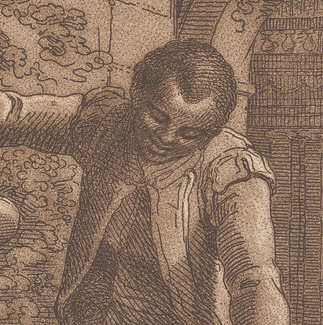
Ottobah Cugoano
c. 1757 — c. 1791 · Akan-born British abolitionist; author of the most thorough early abolitionist treatise by a formerly enslaved African
Quobna Ottobah Cugoano was born around 1757 in Ajumako, in the Fante region of what is now the Central Region of Ghana. He was thirteen when he was kidnapped along with twenty Akan companions while playing in the woods near his village in 1770, sold to slavers at Cape Coast Castle, and transported across the Middle Passage to Grenada.
He was enslaved on a Grenadian sugar plantation for approximately two years. Around 1772 his owner, Alexander Campbell, brought him to England as a personal servant. The Mansfield decision of June 1772 — in the case of the formerly enslaved Jamaican James Somerset, brought before Lord Chief Justice Mansfield — had effectively held that no person in England could be a slave under English common law. Cugoano was baptized at Saint James's Church in Westminster in August 1773, took the baptismal name John Stuart, and was de facto free thereafter.
He worked as a servant in the household of the painters Richard and Maria Cosway through the 1780s. He published in 1787 his Thoughts and Sentiments on the Evil and Wicked Traffic of the Slavery and Commerce of the Human Species — among the first and most thorough abolitionist treatises written and published by a formerly enslaved African in English.
The argument of Thoughts and Sentiments distinguished it from contemporary abolitionist writing: Cugoano argued not for the gradual end of the slave trade but for its immediate abolition, for the freeing of all enslaved persons in British territory, and for the punishment of slave-traders as criminals. He was the first published writer in English to make all three arguments together.
His date of death is uncertain — most likely late 1791, age approximately thirty-four. The Sons of Africa abolitionist circle in which he had worked alongside Olaudah Equiano (also placed in this archive) lost track of him after the autumn of 1791.
He is honored here as the abolitionist whose 1787 treatise first demanded immediate emancipation in print.
Curated with honor.
⚙ Permanence proof
This entry is pinned to the InterPlanetary File System (IPFS) by our own node so that a copy survives independent of any single web host. Anyone with the content identifier below can fetch a verifiable snapshot from any public IPFS gateway — now and decades from now.
To verify independently, paste the CID into any public IPFS gateway (dweb.link, ipfs.io, cf-ipfs.com) — or run your own IPFS node and request the CID directly.
Placed in the archive by the Honored Ancestors editorial team.