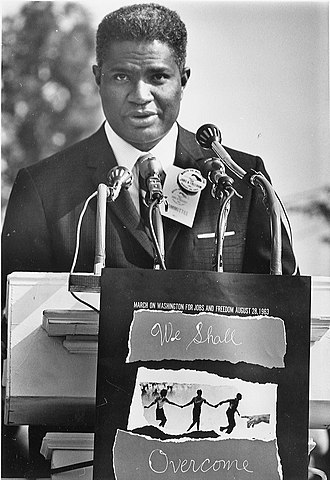
Ossie Davis
1917 — 2005 · Actor, playwright, director and civil-rights orator; delivered the eulogy at the funeral of Malcolm X in February 1965 and at the memorial of Martin Luther King Jr. in 1968
Raiford Chatman Davis was born on the eighteenth of December 1917 at Cogdell, Clinch County, Georgia, the eldest of five children of Kince Charles Davis — a railway construction engineer — and Laura Cooper Davis, a domestic worker. The Davis family had migrated from northern Georgia in the early 1900s following his father's recruitment by the railway lines. He acquired the name Ossie through a clerical error: his mother had pronounced his first name as "R. C. Davis" at the courthouse registration, and the clerk recorded it as "Ossie." He was educated at the segregated Center High School at Waycross, Georgia, and at Howard University, where he studied dramatic literature under Sterling Brown and Alain Locke from 1935 to 1939. He left Howard in 1939 without completing the degree.
He moved to New York and worked through the early 1940s with the Rose McClendon Players in Harlem. He was drafted into the United States Army Medical Corps in 1942 and served in the segregated Black contingents through Liberia and the European theatre until his honourable discharge in 1945. He met Ruby Dee (placed in this archive) at the auditions for the 1946 Broadway production of Robert Ardrey's Jeb. They married in 1948.
He played Joshua Hayward in the original 1946 Broadway run of Jeb, succeeded Sidney Poitier (placed in this archive) as Walter Lee Younger in Lorraine Hansberry's A Raisin in the Sun in 1959, wrote and starred in Purlie Victorious — his own 1961 Broadway comedy — and directed Cotton Comes to Harlem in 1970. He appeared in over a hundred film and television roles, including Spike Lee's Do the Right Thing (1989) — for which he gave the funeral speech that opens the film — and Jungle Fever (1991).
His decisive public role was as the civil-rights orator who delivered at Faith Temple Church of God in Christ in Harlem on the twenty-seventh of February 1965 the eulogy at the funeral of Malcolm X (placed in this archive). The closing words — "Did you ever talk to Brother Malcolm? Did you ever touch him, or have him smile at you? Did you ever really listen to him? Did he ever do a mean thing? Was he ever himself associated with any violence or any public disturbance? For if you did you would know him. And if you knew him, you would know why we must honor him: Malcolm was our manhood, our living, black manhood!" — entered American oratorical history. He delivered three years later the eulogy for Martin Luther King Jr. (placed in this archive) at the Atlanta memorial service.
He died of heart failure at Miami Beach on the fourth of February 2005, at eighty-six.
He is honored here as the orator of Malcolm and Martin.
Curated with honor.
⚙ Permanence proof
This entry is pinned to the InterPlanetary File System (IPFS) by our own node so that a copy survives independent of any single web host. Anyone with the content identifier below can fetch a verifiable snapshot from any public IPFS gateway — now and decades from now.
To verify independently, paste the CID into any public IPFS gateway (dweb.link, ipfs.io, cf-ipfs.com) — or run your own IPFS node and request the CID directly.
Placed in the archive by the Honored Ancestors editorial team.