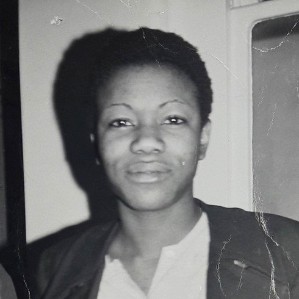
Olive Morris
1952 — 1979 · Black British activist; co-founder of the Brixton Black Women's Group and the Organisation of Women of Asian and African Descent; died at twenty-seven
Olive Elaine Morris was born in Harewood, Saint Catherine Parish, Jamaica, on the twenty-sixth of June 1952. Her family emigrated to Brixton, South London, in 1961. She attended Heathbrook Primary and Lavender Hill Girls' School and took her A levels through evening study while working.
She became active in the British Black Power movement at sixteen. The 1969 incident in which Morris was assaulted by Metropolitan Police officers outside the Desmond Trotter Defence Committee meeting at the Manchester Road Recreation Ground in Brixton — for which she was charged with assaulting a police officer and convicted to a three-month suspended sentence — established her as a public figure in the British Black Power circles around the Black Panther Movement and the Black Liberation Front.
She co-founded the Brixton Black Women's Group in 1973 — the first organized political movement of Black British women — and the Organisation of Women of Asian and African Descent (OWAAD) in 1978, the first cross-Asian-and-African women's political organization in Britain. She was one of the founders of the squatters' movement in Brixton and Railton Road, contributing to the housing-rights campaigns that produced the 1977 Greater London Council housing settlement.
She took her undergraduate degree at Manchester University in social science (1972-75) and was active there in the Manchester Black Women's Co-operative. She traveled to China and Northern Ireland in the late 1970s and worked across multiple post-colonial solidarity movements.
She was diagnosed with non-Hodgkin lymphoma in mid-1978. The treatment failed; she died at Saint Thomas' Hospital in Lambeth on the twelfth of July 1979, age twenty-seven.
The Lambeth Council named the Brixton municipal building on Brixton Hill the Olive Morris House in 1986 — the first London municipal building named for a Black woman. The Brixton Black Women's Group continued under successive generations of leaders into the present.
She is honored here as the activist whose seven years of public organizing built two of Black Britain's foundational women's political institutions.
Curated with honor.
⚙ Permanence proof
This entry is pinned to the InterPlanetary File System (IPFS) by our own node so that a copy survives independent of any single web host. Anyone with the content identifier below can fetch a verifiable snapshot from any public IPFS gateway — now and decades from now.
To verify independently, paste the CID into any public IPFS gateway (dweb.link, ipfs.io, cf-ipfs.com) — or run your own IPFS node and request the CID directly.
Placed in the archive by the Honored Ancestors editorial team.