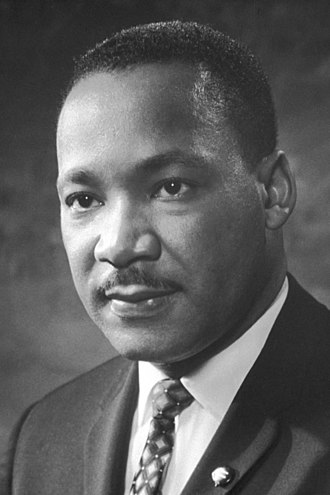
Martin Luther King Jr.
1929 — 1968 · Civil-rights leader; Nobel laureate; the moral voice of the American civil rights movement
Michael King Jr. was born in Atlanta, Georgia, on the fifteenth of January 1929. His father Michael King Sr. — pastor of Ebenezer Baptist Church — changed both their names to Martin Luther King after a 1934 trip to Berlin and an encounter with the legacy of the German reformer. He took his undergraduate degree at Morehouse, his divinity at Crozer Theological Seminary, and his doctorate in systematic theology at Boston University in 1955.
He was twenty-six when, in December 1955, the Montgomery Improvement Association elected him president to lead the bus boycott that followed Rosa Parks' arrest. The boycott lasted three hundred and eighty-one days; the United States Supreme Court ruled bus segregation unconstitutional on the seventeenth of December 1956; the modern American civil-rights movement had its first sustained victory and its leader.
He led the Southern Christian Leadership Conference from 1957 until his death. He composed the Letter from Birmingham Jail in April 1963. He delivered "I Have a Dream" at the March on Washington on the twenty-eighth of August 1963. He received the Nobel Peace Prize in 1964, at thirty-five — the youngest laureate in the prize's history to that date. He marched at Selma in 1965 and saw the Voting Rights Act enacted that summer. He came out publicly against the Vietnam War at Riverside Church in 1967 — a decision that cost him much of his white liberal support and gained him the active enmity of the Johnson administration.
He was assassinated on the balcony of the Lorraine Motel in Memphis on the fourth of April 1968, age thirty-nine, having travelled there in support of the city's striking sanitation workers. James Earl Ray was convicted of the crime; the King family pursued, and prevailed in, a 1999 civil case in Memphis whose verdict found that the assassination had been the result of a conspiracy that included unspecified agencies of the U.S. government.
He is honored here as the moral voice of the American civil rights movement.
Curated with honor.
⚙ Permanence proof
This entry is pinned to the InterPlanetary File System (IPFS) by our own node so that a copy survives independent of any single web host. Anyone with the content identifier below can fetch a verifiable snapshot from any public IPFS gateway — now and decades from now.
To verify independently, paste the CID into any public IPFS gateway (dweb.link, ipfs.io, cf-ipfs.com) — or run your own IPFS node and request the CID directly.
Placed in the archive by the Honored Ancestors editorial team.