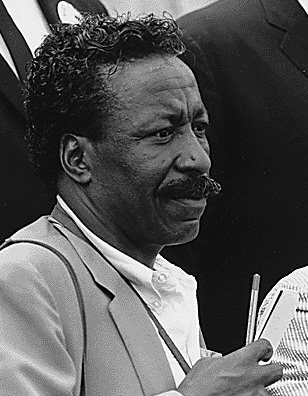
Gordon Parks
1912 — 2006 · Photographer, filmmaker, composer; first African American photographer at Life and at Vogue; first African American to direct a major Hollywood feature
Gordon Roger Alexander Buchanan Parks was born in Fort Scott, Kansas, on the thirtieth of November 1912, the youngest of fifteen children of a tenant farmer and his wife. His mother died when Gordon was fourteen. He was effectively homeless for several years before settling in Saint Paul, Minnesota.
He worked as a railroad dining-car waiter through his early twenties. He bought his first camera at a Seattle pawnshop in 1937 for seven dollars and fifty cents. He began as a fashion photographer in Saint Paul, joined the Farm Security Administration documentary-photography program in 1942 under Roy Stryker, and produced through the 1940s the principal photographic record of Black Washington, D.C., and the rural Black South.
In 1948 Life magazine hired him — making him the first African American staff photographer at the publication. He worked at Life for twenty-three years and produced the photo essays that defined his reputation: Harlem Gang Leader (1948), Flavio (1961, on a young boy in a Rio favela), Black Muslims (1963), and the Civil Rights essays of the 1960s.
He was the first African American photographer signed by Vogue (1948), the first to direct a major Hollywood feature (The Learning Tree, 1969 — adapted from his autobiographical novel), and the director of Shaft (1971), one of the most commercially successful Black-led films in American history.
He composed scores for his own films, published nineteen books across photography, fiction, autobiography, and poetry, and founded Essence magazine in 1970 as a co-founder of the parent corporation. He received the National Medal of Arts in 1988 and the Gordon Parks Foundation, established in 2006, continues to support emerging photographers.
He died in New York on the seventh of March 2006, age ninety-three.
He is honored here as the photographer and filmmaker whose multi-disciplinary career reframed Black visual representation in American media.
Curated with honor.
⚙ Permanence proof
This entry is pinned to the InterPlanetary File System (IPFS) by our own node so that a copy survives independent of any single web host. Anyone with the content identifier below can fetch a verifiable snapshot from any public IPFS gateway — now and decades from now.
To verify independently, paste the CID into any public IPFS gateway (dweb.link, ipfs.io, cf-ipfs.com) — or run your own IPFS node and request the CID directly.
Placed in the archive by the Honored Ancestors editorial team.