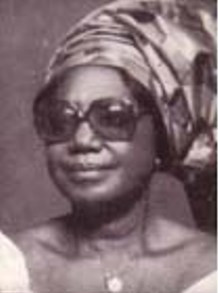
Flora Nwapa
1931 — 1993 · Oguta-born Nigerian Igbo novelist; author of the 1966 novel Efuru — the first novel in English by a Black African woman published by an international press
Florence Nwanzuruahu Nkiru Nwapa was born on the thirteenth of January 1931 at Oguta, on Oguta Lake in the Imo State of eastern Nigeria — the same lakeside Igbo trading town she would furnish as the setting of her first novel Efuru thirty-five years later — the daughter of Christopher Nwapa, a Niger Coast Protectorate trading clerk, and Martha Onyema Nwapa, an evangelist of the United Free Methodist Mission.
She was raised in the United Free Methodist Mission compound of her mother at Oguta and educated at the Mission’s primary school. She was placed at twelve at the Archdeacon Crowther Memorial Girls’ School at Elelenwa, near Port Harcourt, and at eighteen at the CMS Girls’ School at Lagos, completing the school certificate there in 1949.
She took the bachelor’s in arts at the University College Ibadan in 1957 — among the first generation of Black West African women to take an English-medium university degree — and the postgraduate diploma in education at the University of Edinburgh in 1958.
She took employment in 1958 as a Woman Education Officer of the Federal Ministry of Education at Calabar and from 1962 to 1967 as the assistant registrar of the University of Lagos.
She wrote across the early 1960s the manuscript of Efuru — the chronicle of the Oguta woman Efuru Nwosu across two marriages, the loss of her only child, and the eventual reclamation of her independence under the protection of the lake goddess Uhamiri. The manuscript was sent on the recommendation of Chinua Achebe (placed in this archive), then the founding editor of the Heinemann African Writers Series, to William Heinemann at London. Efuru was published at London in 1966 as Volume 26 of the African Writers Series — the first novel in English by a Black African woman published by an international press.
She served the Republic of Biafra during the Nigerian Civil War of 1967 to 1970 as the Biafran Minister of Health and Social Welfare and after the war the East Central State Commissioner for Health and Social Welfare from 1970 to 1971 and Commissioner for Lands, Survey and Urban Development from 1971 to 1974.
She founded in 1974 the Tana Press at Enugu — the first Black African woman-owned book-publishing house in Africa.
She published across the following twenty years four further novels and three short-story collections — among them Idu (1970), Never Again (1975), One is Enough (1981), and Women Are Different (1986).
She died at Enugu on the sixteenth of October 1993 of complications of pneumonia, at sixty-two.
She is honored here as the author of Efuru.
Curated with honor.
⚙ Permanence proof
This entry is pinned to the InterPlanetary File System (IPFS) by our own node so that a copy survives independent of any single web host. Anyone with the content identifier below can fetch a verifiable snapshot from any public IPFS gateway — now and decades from now.
To verify independently, paste the CID into any public IPFS gateway (dweb.link, ipfs.io, cf-ipfs.com) — or run your own IPFS node and request the CID directly.
Placed in the archive by the Honored Ancestors editorial team.