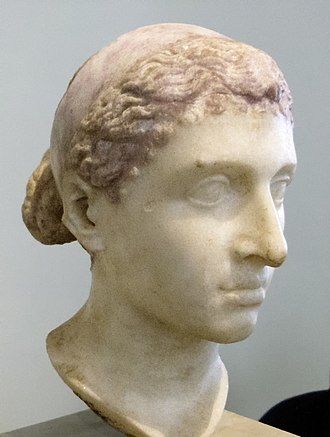
Cleopatra VII Philopator
69 BCE — 30 BCE · Last pharaoh of Egypt; the most politically formidable woman of the classical Mediterranean world
Cleopatra Thea Philopator was born in Alexandria in 69 BCE, daughter of Ptolemy XII Auletes of the Macedonian-Greek dynasty that had ruled Egypt since the death of Alexander the Great two and a half centuries earlier. She was, according to Plutarch, the first member of the Ptolemaic line in three hundred years to learn the Egyptian language. She also spoke Greek, Latin, Hebrew, Aramaic, Ethiopic, Arabic, Syriac, Median, and Parthian — Plutarch's count, supported across multiple ancient sources.
She became queen at eighteen, jointly with her younger brother Ptolemy XIII. By twenty-one she had survived two civil wars, allied with Julius Caesar against her brother, and emerged as sole ruler of Egypt — the richest, most agriculturally productive territory in the Roman sphere. Her affair with Caesar produced a son. After Caesar's assassination she allied with Mark Antony; her affair with him produced three more children and constituted, for the better part of a decade, a parallel political power center that the Roman Senate could not absorb.
The end came at Actium in 31 BCE: a sea battle off the Greek coast in which Octavian's fleet defeated Antony's. Cleopatra returned to Alexandria, watched Antony die, refused to be paraded as a captive in Octavian's Roman triumph, and took her own life in August of 30 BCE — by tradition the bite of an asp, by modern scholarship more likely poison. She was thirty-nine.
Rome annexed Egypt within the year. Octavian became Augustus, the first Roman emperor. The Ptolemaic dynasty ended with Cleopatra. She was the last sovereign of independent Egypt for almost two thousand years.
She is honored here as the last pharaoh of Egypt, and the most politically formidable woman of the classical Mediterranean world.
Curated with honor.
⚙ Permanence proof
This entry is pinned to the InterPlanetary File System (IPFS) by our own node so that a copy survives independent of any single web host. Anyone with the content identifier below can fetch a verifiable snapshot from any public IPFS gateway — now and decades from now.
To verify independently, paste the CID into any public IPFS gateway (dweb.link, ipfs.io, cf-ipfs.com) — or run your own IPFS node and request the CID directly.
Placed in the archive by the Honored Ancestors editorial team.