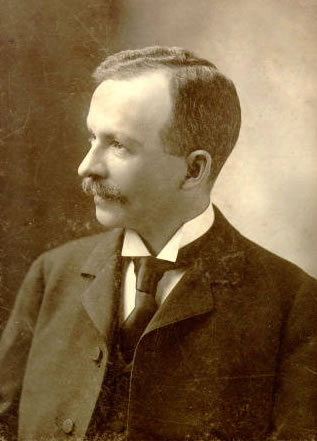
Charles W. Chesnutt
1858 — 1932 · Novelist and short-story writer; first African American writer of fiction to receive sustained critical and commercial recognition from a mainstream American press
Charles Waddell Chesnutt was born on the twentieth of June 1858 at Cleveland, Ohio, the eldest of three sons of Andrew Jackson Chesnutt — a free Black grocery clerk from Fayetteville, North Carolina, who had migrated to Cleveland during the late 1850s — and Ann Maria Sampson Chesnutt, also of free Black North Carolina background. The family returned to Fayetteville at the close of the Civil War in 1866. He completed at fourteen the upper-grades curriculum of the Howard School at Fayetteville and was retained at sixteen as assistant principal.
He served as a teacher and principal at Fayetteville, at the State Normal School of Charlotte, and from 1880 as the first principal of the State Colored Normal School of Fayetteville — the institution that would later become Fayetteville State University. He left Fayetteville in 1883 for New York and then for Cleveland in 1884, where he settled and remained for the rest of his life. He completed the Ohio bar examination in 1887 and established a successful court-reporting firm in Cleveland in 1888.
He published his first story — "The Goophered Grapevine" — in the August 1887 Atlantic Monthly. The story was the first work of fiction by an African American writer to be published in the principal American literary monthly without the author's race being disclosed; Chesnutt deliberately withheld it. He published across the following fifteen years two collections of short stories — The Conjure Woman of 1899 and The Wife of His Youth and Other Stories of the Color Line of 1899 — and three novels: The House Behind the Cedars of 1900, The Marrow of Tradition of 1901 and The Colonel's Dream of 1905.
The Marrow of Tradition of 1901 — the historical novel of the November 1898 Wilmington massacre and political coup d'état — is widely regarded by current historiography as one of the principal American novels of its century. The mainstream critical response of 1901 was hostile; the book sold poorly and Chesnutt withdrew thereafter from the literary marketplace, returning to his court-reporting practice from 1905.
He published intermittently through the remaining twenty-seven years of his life but produced no further novels of the scope of The Marrow of Tradition. He received the Spingarn Medal of the NAACP in 1928 in recognition of his pioneer literary work.
He died of complications of cerebral arteriosclerosis at Cleveland on the fifteenth of November 1932, at seventy-four.
He is honored here as the founder of the post-Reconstruction African American novel.
Curated with honor.
⚙ Permanence proof
This entry is pinned to the InterPlanetary File System (IPFS) by our own node so that a copy survives independent of any single web host. Anyone with the content identifier below can fetch a verifiable snapshot from any public IPFS gateway — now and decades from now.
To verify independently, paste the CID into any public IPFS gateway (dweb.link, ipfs.io, cf-ipfs.com) — or run your own IPFS node and request the CID directly.
Placed in the archive by the Honored Ancestors editorial team.