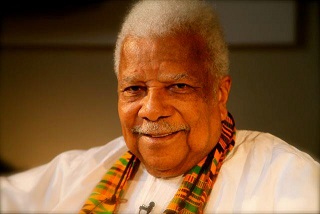
Ali Mazrui
1933 — 2014 · Kenyan-American political scientist; author of The Africans; the most globally circulated African public intellectual of the late twentieth century
Ali Al'amin Mazrui was born on the twenty-fourth of February 1933 in Mombasa on the Swahili coast of Kenya, the son of Sheikh Al-Amin bin Ali Mazrui — the most prominent Islamic jurist of East Africa of the first half of the twentieth century and the chief qadi of Kenya at his death in 1947 — and his second wife Safia Suleiman. The Mazrui family — descended from the Omani Arab nobility who had ruled Mombasa under nominal Omani sovereignty from 1698 to 1837 — had been the leading Muslim scholarly family of the East African coast for ten generations.
He was educated at the Arab Primary School at Mombasa and at the Government Indian Secondary School. He took the British colonial Cambridge Higher School Certificate as the only African candidate at Mombasa in 1955 and was awarded a Kenyan colonial scholarship to read political science at the University of Manchester. He took a first in 1960, the master's at Columbia in 1961, and the D.Phil. at Nuffield College, Oxford, in 1966 — the first East African to receive an Oxford doctorate in political science.
He taught from 1963 to 1973 at the new Makerere University in Uganda and was professor and dean of the social sciences faculty under the Obote and early Amin governments. He left Uganda in 1973 when his protégé Frank Kalimuzo was disappeared by the regime. He held over the following forty years professorial chairs at the University of Michigan, the Institute of Global Cultural Studies at Binghamton University, and the State University of New York. He delivered the BBC Reith Lectures in 1979 — the African Condition — and the United Nations Lectures in 1989. His nine-part documentary series The Africans for the BBC and PBS in 1986 reached, by combined broadcast and rebroadcast, an estimated audience of one hundred million.
He published more than thirty books — Towards a Pax Africana of 1967, Political Values and the Educated Class in Africa of 1978, The African Condition of 1980 — and several hundred essays. He died at Vestal, New York, on the twelfth of October 2014, at eighty-one.
He is honored here as the most globally circulated African political scientist of the twentieth century.
Curated with honor.
⚙ Permanence proof
This entry is pinned to the InterPlanetary File System (IPFS) by our own node so that a copy survives independent of any single web host. Anyone with the content identifier below can fetch a verifiable snapshot from any public IPFS gateway — now and decades from now.
To verify independently, paste the CID into any public IPFS gateway (dweb.link, ipfs.io, cf-ipfs.com) — or run your own IPFS node and request the CID directly.
Placed in the archive by the Honored Ancestors editorial team.