Zora Neale Hurston
1891 — 1960 · Novelist and anthropologist; restored the rural Black-American voice to literary fiction
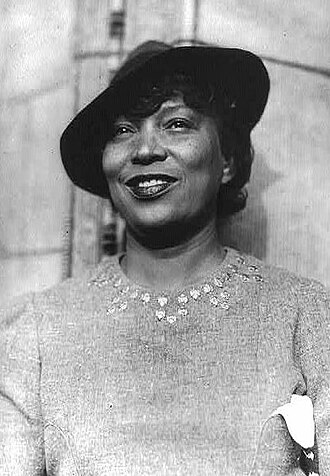
Portrait: Wikimedia Commons, Creative Commons
Zora Neale Hurston was born on January 7, 1891, in Notasulga, Alabama, the daughter of a Baptist preacher and a schoolteacher. While still a small child her family moved to Eatonville, Florida, one of the first all-Black towns incorporated in the United States, where her father served as a Baptist preacher and was elected mayor. Raised inside a self-governing Black community, Hurston absorbed a world where Black life was ordinary, dignified, and whole — a well of memory she would draw from for the rest of her life. In later years she famously gave her birth year as 1901, a revision that began when she needed to qualify for a free high-school education.
She earned an associate degree from Howard University and, in 1928, a bachelor's degree in anthropology from Barnard College, where she studied under the pioneering anthropologist Franz Boas before pursuing graduate work at Columbia University. This training gave her a rare double vision: she was at once an artist and a rigorous field collector of African American and Caribbean folklore, gathering songs, sermons, tales, and folkways across the American South, Jamaica, and Haiti.
Hurston became a central figure of the Harlem Renaissance, and her fieldwork bore fruit in the landmark folklore studies "Mules and Men" (1935) and "Tell My Horse" (1938). Her novels — "Jonah's Gourd Vine" (1934), "Moses, Man of the Mountain" (1939), and above all "Their Eyes Were Watching God" (1937) — restored the rural Black-American voice, its speech and its inner life, to serious literary fiction. She also published the autobiography "Dust Tracks on a Road" (1942).
Her final years were marked by hardship and neglect; she died on January 28, 1960, in Fort Pierce, Florida, and was buried in an unmarked grave. In 1973 the writer Alice Walker sought out that grave and set a marker naming her "A Genius of the South," beginning the revival that returned Hurston to her rightful place in the American canon. She gave a whole people back their voice, and that voice endures.
Keep a life of your own
Every family has a life like this one. Begin with yours.
Sources
- Zora Neale Hurston | Biography, Books, Short Stories, & Facts | Britannica (www.britannica.com)
- Zora Neale Hurston - Wikipedia (en.wikipedia.org)
- Hurston, Zora Neale - Encyclopedia of Alabama (encyclopediaofalabama.org)
The house names where it read; it does not send you off the house's own pages.
The proof
This life is kept with a public fingerprint anyone can check.
bafkreie3rwitl25y5fqursiqeyuhb4hozv7p6vohlnpydvolrz2kge2zcu
Something here is wrong, or missing? Write to info@honoredancestors.com with the source; a person at the house reads every letter, and a correction is made only from a source.