
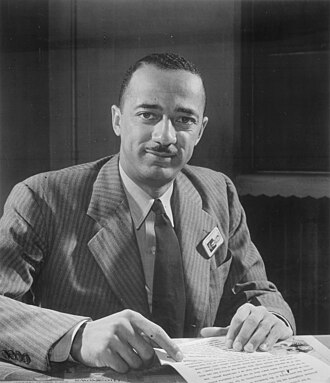
William Hastie
1904 — 1976 · The first African American federal judge in United States history; appointed to the United States District Court of the Virgin Islands in 1937 and to the United States Court of Appeals for the Third Circuit in 1949
Portrait: Wikimedia Commons, Creative Commons
William Henry Hastie was born on the seventeenth of November 1904 at Knoxville, Tennessee, the only child of William Henry Hastie Sr. — a clerk in the United States Pension Office — and Roberta Childs Hastie, a schoolteacher and a granddaughter of one of the founders of the Knoxville College for Negroes. The family moved to Washington, D.C., when he was eleven. He graduated valedictorian of the segregated Dunbar High School in 1921 and took the bachelor's degree at Amherst College in 1925 — magna cum laude, Phi Beta Kappa, and valedictorian of his class. He completed the LL.B. at Harvard Law School in 1930 — where he was the editor of the Harvard Law Review under Felix Frankfurter — and the Doctor of Juridical Science at Harvard in 1933.
He joined the new Howard Law School faculty in 1930 under his Harvard classmate Charles Hamilton Houston (placed in this archive). The Howard Law School under the Hastie-Houston deanship became across the following decade the principal training ground of the civil-rights bar that would within a generation argue Brown v. Board of Education. He served simultaneously from 1933 to 1937 as assistant solicitor of the United States Department of the Interior under Harold Ickes — the highest civilian position held by an African American in the federal executive branch.
On the twenty-sixth of March 1937 President Franklin Roosevelt appointed him judge of the United States District Court of the Virgin Islands — the first African American federal judge of the United States. He resigned in February 1939 to accept the deanship of Howard Law School, returning in 1940 to Washington as civilian aide to Secretary of War Henry L. Stimson on Negro affairs. He resigned the War Department post in January 1943 in protest at racial segregation in the Army Air Forces — the protest produced the executive order that subsequently desegregated the wartime Air Forces.
He was appointed Governor of the United States Virgin Islands by President Truman in 1946 — the first African American governor of any United States territory. On the seventeenth of October 1949 Truman elevated him to the United States Court of Appeals for the Third Circuit. He served on the Third Circuit for the following twenty-one years, including as Chief Judge from 1968 to 1971.
He died at Philadelphia on the fourteenth of April 1976, at seventy-one.
He is honored here as the first African American federal judge.
Keep a life of your own
Every family has a life like this one. Begin with yours.
Sources
- William H. Hastie - Wikipedia (en.wikipedia.org)
- William Henry Hastie | Encyclopedia.com (www.encyclopedia.com)
- Hastie's legacy is one of inspiration - Knox TN Today (www.knoxtntoday.com)
The house names where it read; it does not send you off the house's own pages.
The proof
This life is kept with a public fingerprint anyone can check.
bafkreieu2q2ugu6py6gocls52earikhrv5trgchvopsxltbwo6ezhj4bdu
Something here is wrong, or missing? Write to info@honoredancestors.com with the source; a person at the house reads every letter, and a correction is made only from a source.