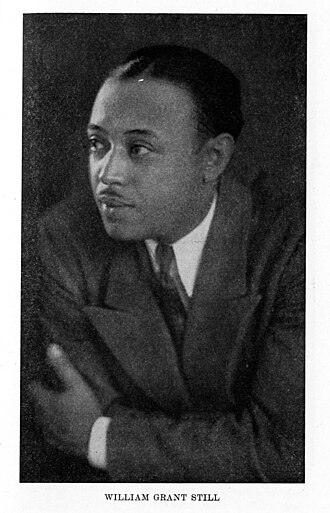
William Grant Still
1895 — 1978 · Mississippi-born composer; the first African American to have a symphony performed by a major American orchestra — the 1931 premiere of his Afro-American Symphony by the Rochester Philharmonic — and to conduct one
Portrait: Wikimedia Commons, Creative Commons
William Grant Still was born on the eleventh of May 1895 at Woodville, Mississippi, the son of William Grant Still Sr. — a partner at a Black-owned grocery and a part-time bandleader, who died when his son was three months old — and Carrie Lena Fambro Still, a schoolteacher. The family moved to Little Rock, Arkansas in 1895 following the father’s death, and the mother remarried Charles B. Shepperson, who introduced Still to operatic recordings on a Victrola in the household parlour.
He was admitted at sixteen in 1911 to the Wilberforce University in Ohio in pre-medical studies but transferred at the end of his second year into music, where he played the oboe and the violin in the university band under his self-instruction.
He served in the United States Navy in 1918 as a mess attendant on the USS Kroonland, returning to a post-war Harlem then in the early stages of the Harlem Renaissance. He took employment as a chamber arranger for the W. C. Handy publishing house, the Black Swan recording company, the Eubie Blake and Noble Sissle revues, the Sophie Tucker tours, and the Paul Whiteman orchestra across the 1920s.
He enrolled in 1923 at the New England Conservatory of Music under George Whitefield Chadwick and at the same time at the Conservatoire Americain at Fontainebleau under Edgard Varèse in private study at New York.
He completed in 1930 the Afro-American Symphony in A-flat — a four-movement symphonic work integrating a twelve-bar blues melody as the first-movement principal theme — and the Rochester Philharmonic under Howard Hanson premiered it on the twenty-eighth of October 1931 at the Eastman Theatre at Rochester, New York.
He conducted the Los Angeles Philharmonic on the twenty-third of July 1936 at the Hollywood Bowl — the first African American to conduct a major American orchestra in the standard concert repertoire.
He composed across the following forty years nine symphonies, eight operas — among them Troubled Island (1949), the first opera by an African American performed by the New York City Opera — and over two hundred works total.
He died at Los Angeles on the third of December 1978, at eighty-three.
He is honored here as the first African American symphonist of the American concert hall.
Keep a life of your own
Every family has a life like this one. Begin with yours.
Sources
- William Grant Still - Wikipedia (en.wikipedia.org)
- Mississippi Composer and Conductor, William Grant Still - Mississippi Writers & Musicians (www.mswritersandmusicians.com)
The house names where it read; it does not send you off the house's own pages.
The proof
This life is kept with a public fingerprint anyone can check.
bafkreiertbojvah5rsa7kpyfmdrcdac7yux4av4hqfhjoxs7e7goazjw3m
Something here is wrong, or missing? Write to info@honoredancestors.com with the source; a person at the house reads every letter, and a correction is made only from a source.