
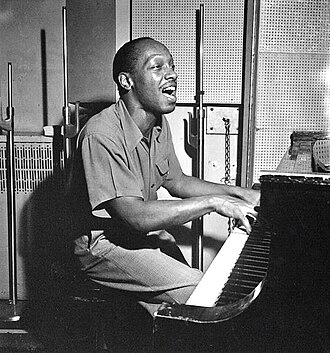
Tadd Dameron
1917 — 1965 · Cleveland-born American jazz composer and arranger; principal bebop composer-arranger of the principal late-1940s American bebop tradition; composer of 'Good Bait' of 1944 and 'Hot House' of 1945
Portrait: Wikimedia Commons, Creative Commons
Tadley Ewing Peake Dameron was born on 21 February 1917 in Cleveland, Ohio, to Isaiah Peake and Ruth Harris Peake. He entered the world under the surname Peake; it was only after his parents divorced and his mother remarried Adolphus Dameron, who adopted the boy around 1924, that Tadd and his older brother Caesar came to carry the name Dameron. Music surrounded him from the first: his mother set him at the piano near the age of four, teaching him by ear and memory rather than by the printed page, and Caesar, a saxophonist, drew him toward the records of the great big bands.
Coming of age in Cleveland, Dameron grew into an arranger of rare harmonic imagination. In the early 1940s he wrote charts for Harlan Leonard and His Rockets, and before long his hand shaped the books of Count Basie, Jimmie Lunceford, Billy Eckstine, Dizzy Gillespie, and Sarah Vaughan. Dizzy Gillespie premiered several of his finest works, and in 1948 introduced Dameron's extended orchestral piece Soulphony at Carnegie Hall.
He became the definitive composer-arranger of the bebop era, a writer who gave the new music warmth and lyric grace. His pen produced enduring standards — "Good Bait," "Hot House," "Lady Bird," "Our Delight," and the tender ballad "If You Could See Me Now," written for Sarah Vaughan. Leading small groups on the East Coast and in Europe from the late 1940s into the 1950s, he framed the incandescent trumpets of Fats Navarro and, later, Clifford Brown.
Illness and hardship shadowed his final years, and he died on 8 March 1965 in New York City. Dexter Gordon called him the "romanticist" of bebop — the man who taught a revolution how to sing. May his melodies keep his name in honor.
Keep a life of your own
Every family has a life like this one. Begin with yours.
Sources
- Tadd Dameron - Wikipedia (en.wikipedia.org)
- DAMERON, TADLEY "TADD" EWING | Encyclopedia of Cleveland History | Case Western Reserve University (case.edu)
- Tadd Dameron | Jazz Arranger, Bebop Composer | Britannica (www.britannica.com)
The house names where it read; it does not send you off the house's own pages.
The proof
This life is kept with a public fingerprint anyone can check.
bafkreianoxwmmaupx23pkfny6h2ijfypewcvtxxnmd6w23of3iyxpkzma4
Something here is wrong, or missing? Write to info@honoredancestors.com with the source; a person at the house reads every letter, and a correction is made only from a source.