
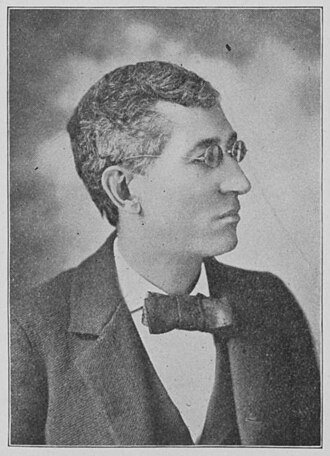
T. Thomas Fortune
1856 — 1928 · Founder of the New York Age; principal Black newspaper editor of the late nineteenth century; founder of the National Afro-American League — predecessor of the NAACP
Portrait: Wikimedia Commons, Creative Commons
Timothy Thomas Fortune was born into slavery on the third of October 1856 at Marianna in Jackson County, Florida, the son of Emanuel Fortune — an enslaved cobbler — and Sarah Jane Fortune, an enslaved washerwoman. The family was emancipated in 1865; his father served in the Reconstruction Florida State Legislature from 1868 to 1870 before fleeing political violence to Jacksonville. Fortune attended the public school at Jacksonville from 1869 and apprenticed at fourteen as a typesetter on the Jacksonville Daily Union. He attended Howard University Law School for a single semester in 1876 before financial necessity forced him to leave Washington.
He moved to New York in 1879 and worked as a typesetter on the Sun and the Weekly Witness before founding in 1881 the Black weekly newspaper Globe with George Parker. The Globe was reorganised as the New York Freeman in 1884 and as the New York Age in 1887, under which name it operated for the following four decades as the most influential Black newspaper of the late nineteenth and early twentieth century. Fortune was its principal editor from 1881 to 1907 and again from 1923 to his death.
He founded in January 1890 at Chicago the National Afro-American League — the first national organisation explicitly devoted to the legal and political defence of African American civil rights. The League's six declared objectives — suppression of mob violence, abolition of penitentiary leasing systems, equal taxation and equal apportionment of school funds, the franchise, equal access to public accommodations, and equal access to the courts — established the agenda that would across the next century pass to the Afro-American Council (1898), to the Niagara Movement (1905), and to the NAACP (1909).
He was the closest journalistic ally of Booker T. Washington (placed in this archive) from 1885 to 1907 — editing the principal Black newspaper that supported Washington's Tuskegee programme and writing many of Washington's published articles — and the principal target of W. E. B. Du Bois's (placed in this archive) criticism of Washington's accommodationism. He suffered a severe mental breakdown in 1907 and lost editorial control of the Age that year. He recovered partially across the 1910s and edited Marcus Garvey's (placed in this archive) Negro World from 1923 to his death.
He died at Philadelphia on the second of June 1928, at seventy-one.
He is honored here as the founder of the National Afro-American League.
Keep a life of your own
Every family has a life like this one. Begin with yours.
Sources
- Timothy Thomas Fortune - Wikipedia (en.wikipedia.org)
- T. Thomas Fortune | Encyclopedia.com (www.encyclopedia.com)
- Timothy Thomas Fortune | History | Research Starters | EBSCO Research (www.ebsco.com)
- T. Thomas Fortune | The Black Press (PBS) (www.pbs.org)
The house names where it read; it does not send you off the house's own pages.
The proof
This life is kept with a public fingerprint anyone can check.
bafkreia3vxktsegzyvduxqjfqwm52h4wnekgvhrc5aumr3yz4k5qtp5tha
Something here is wrong, or missing? Write to info@honoredancestors.com with the source; a person at the house reads every letter, and a correction is made only from a source.