
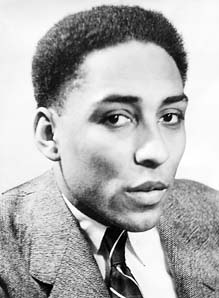
St. Clair Drake
1911 — 1990 · Anthropologist; co-author of Black Metropolis; founder of the African Studies Program at Stanford
Portrait: Wikimedia Commons, Creative Commons
John Gibbs St. Clair Drake was born on January 2, 1911, in Suffolk, Virginia, the son of a Barbadian-immigrant Baptist minister who organized for Marcus Garvey's Universal Negro Improvement Association. That heritage of diaspora and race-conscious purpose shaped his life's work. He took his undergraduate degree in biology at the Hampton Institute in 1931, then turned toward the study of human society, entering graduate work in anthropology at the University of Chicago, where he earned his doctorate in 1954.
Drake's enduring monument is Black Metropolis: A Study of Negro Life in a Northern City, co-authored with Horace R. Cayton and published in 1945. A landmark of urban ethnography, it dissected the making of Black Chicago with rigor and empathy, won the Anisfield-Wolf Award, and remains a foundation stone of American sociology and anthropology.
His vision was never confined to one continent. From 1958 to 1961 he served as head of the Department of Sociology at the University of Ghana, joining the intellectual life of a newly independent African nation. Returning home, he taught for more than two decades at Roosevelt University before, in 1969, founding and directing the African and Afro-American Studies program at Stanford University, among the first of its kind in the country.
In his final years he completed Black Folk Here and There, a sweeping study of race across world history. St. Clair Drake gave his life to naming injustice plainly and to building the institutions that would carry Black scholarship forward. May his clarity, his courage, and his unbroken bridge between the diaspora and Africa be forever honored.
Keep a life of your own
Every family has a life like this one. Begin with yours.
Sources
- St. Clair Drake - Wikipedia (en.wikipedia.org)
- St. Clair Drake | Encyclopedia.com (www.encyclopedia.com)
- St. Clair Drake (1911-1990) | BlackPast.org (blackpast.org)
The house names where it read; it does not send you off the house's own pages.
The proof
This life is kept with a public fingerprint anyone can check.
bafkreia7srra2yw2s72q2esh5txqqn5x2u6u3muwqvjiwpmlcas663vfha
Something here is wrong, or missing? Write to info@honoredancestors.com with the source; a person at the house reads every letter, and a correction is made only from a source.