St. Clair Bourne
1943 — 2007 · Long Island-born American documentary filmmaker; director of Let the Church Say Amen! of 1973, In Motion: Amiri Baraka of 1982, and Paul Robeson: Here I Stand of 1999; principal documentary filmmaker of the Black Arts Movement
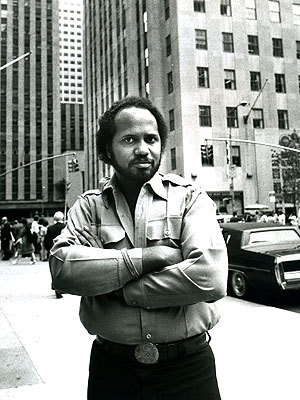
Portrait: Wikimedia Commons, Creative Commons
St. Clair Cecil Bourne was born on the sixteenth of February 1943 in Harlem, New York, into a household already devoted to chronicling Black American life. His father, the journalist St. Clair T. Bourne, wrote for the New York Amsterdam News and the People's Voice, and his mother worked as a nurse. The family moved to Brooklyn when he was a small child, and from his father's example he inherited a reporter's eye and a conviction that the stories of his people deserved to be told with rigor and respect.
He studied at Georgetown's School of Foreign Service and served in the Peace Corps before entering Columbia University, from which he was expelled in the late 1960s for his part in the campus antiwar protests. That rupture proved a beginning: he was brought to the pioneering public-television program Black Journal, where he rose to full producer and earned an Emmy, learning to wield the documentary form as an instrument of witness.
Founding his own company, Chamba Productions, Bourne directed and produced more than forty films across a career of some thirty-six years. His work gave lasting shape to Black cultural memory — from Let the Church Say Amen! (1973), his study of the Black church, to In Motion: Amiri Baraka (1982) and Paul Robeson: Here I Stand (1999). He became the principal documentary filmmaker of the Black Arts Movement, and taught at Cornell, Queens College, UCLA, and Yale.
He died in Manhattan on the fifteenth of December 2007, at sixty-four. Through the more than forty films he left behind, St. Clair Bourne endures as a keeper of Black American memory, and his archive remains a light for those who came after.
Keep a life of your own
Every family has a life like this one. Begin with yours.
Sources
- St. Clair Bourne - Wikipedia (en.wikipedia.org)
- St. Clair Bourne Collection — Black Film Center & Archive, Indiana University Bloomington (bfca.indiana.edu)
- The Bourne Legacy | International Documentary Association (www.documentary.org)
The house names where it read; it does not send you off the house's own pages.
The proof
This life is kept with a public fingerprint anyone can check.
bafkreidyn76oxrol7rccnn3k7pdq27xcsdtwbpemctltg3kdobs62c73qi
Something here is wrong, or missing? Write to info@honoredancestors.com with the source; a person at the house reads every letter, and a correction is made only from a source.