
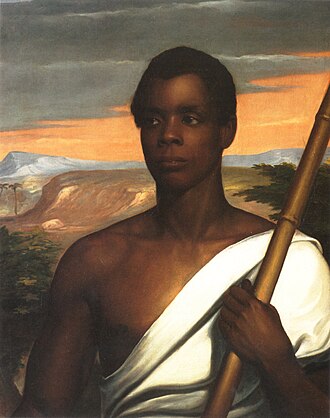
Sengbe Pieh
c. 1814 — c. 1879 · Mende farmer who led the Amistad revolt; freed by the Supreme Court of the nation that jailed him; carried his people home
Portrait: Wikimedia Commons, Creative Commons
Sengbe Pieh — the name the Havana slavers overwrote with Joseph Cinqué — was born about 1814 at Mani, a Mende town in the interior of present-day Sierra Leone. A rice farmer, married, father of a son and two daughters, he was seized in early 1839, held at the Lomboko barracoons on the Gallinas coast, and shipped illegally aboard the Tecora to Cuba, where he was sold under false papers in Havana to José Ruiz and Pedro Montes and loaded onto the schooner La Amistad.
On the night of the first into the second of July 1839, three days out of Havana — after the cook Celestino had taunted the captives with signs that they would be killed and eaten — Sengbe led the Africans up from the hold armed with sugar-cane knives. Captain Ferrer and the cook were killed, Sengbe credited with the blow that felled the captain; the two owners were spared to sail the ship toward Africa. By day they steered into the sun's rising; by night the Spaniards crept the helm north and west, and the zigzag voyage ended off Montauk on the twenty-sixth of August, when the survey brig Washington seized the schooner and carried her captives to Connecticut.
From the New Haven jail, the Mende's cause rose through the courts of a nation arguing with itself. The district and circuit courts ruled them free; the government appealed; and John Quincy Adams, an old man and a former president, stood before the Supreme Court for them. On the ninth of March 1841 the Court held that they had been kidnapped free men — never lawfully slaves — and were free. With the missionaries of the Mende Mission, raised up by the Amistad Committee and the Black-led Union Missionary Society, the thirty-five survivors sailed that November and touched Sierra Leone in January 1842.
His later years are dim in the record; his family, by the accounts, had been lost to war. Missionary tradition holds that in 1878 an old man came to the Mende Mission announcing he had come home to die, and that Sengbe Pieh was buried there in 1879. Honored be Sengbe Pieh, who rose from the hold, won his freedom in the conqueror's highest court, and went home.
Keep a life of your own
Every family has a life like this one. Begin with yours.
Sources
- Sengbe Pieh — nps.gov (www.nps.gov)
- Sengbe Pieh — Wikipedia (en.wikipedia.org)
- Sengbe Pieh — Britannica (www.britannica.com)
The house names where it read; it does not send you off the house's own pages.
The proof
This life is kept with a public fingerprint anyone can check.
bafkreibybtdaehx4nsz2mlzh3krj7xz5jyegjbr63cuaowgur7l2hvr4fq
Something here is wrong, or missing? Write to info@honoredancestors.com with the source; a person at the house reads every letter, and a correction is made only from a source.