
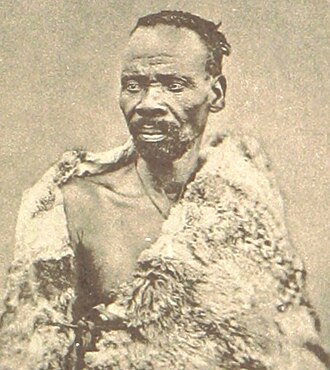
Sekhukhune I
c. 1814 — 1882 · King of the Pedi; defeated successive Boer and British colonial expeditions before his ultimate capture and murder
Portrait: Wikimedia Commons, Creative Commons
Matsebe Sekhukhune was born around 1814, the son of Sekwati I — the king who had refounded the Pedi paramountcy after the dispersal of the Pedi confederacy during the mfecane. Sekhukhune acceded to the Pedi throne in 1861 on his father's death and consolidated Pedi authority across the eastern Transvaal — in what is now the Limpopo Province of South Africa.
His reign was occupied by sustained military and political pressure from two encroaching European-settler powers: the South African Republic (the Boer Transvaal) to the west, and the British Crown to the south. The Sekhukhune War of 1876 — the first major Boer-Pedi war — saw a Transvaal commando of approximately two thousand defeat. Sekhukhune's Pedi forces inflicted heavy casualties, withdrew into the Leolu Mountains, and held them under siege for several months. The Transvaal force eventually withdrew in failure, and the inconclusive war was one of the principal weaknesses the British cited in their 1877 annexation of the Transvaal.
The British colonial Sekhukhune War of 1879 followed. The British force under Sir Garnet Wolseley — fresh from the defeat of the Zulu at the Battle of Ulundi earlier that year — combined some thirteen hundred British regular troops, eight thousand Swazi auxiliaries, and four hundred Transvaal volunteers. The combined force assaulted Sekhukhune's mountain fortress at Tsate over four days in November and December 1879. Sekhukhune was captured on the second of December 1879 and held at Pretoria as a British colonial prisoner for the next four years.
He was released in 1882 after the Anglo-Transvaal War had ended the British annexation of the Transvaal and was returned to his Pedi kingdom under conditions that made him essentially a tributary of the restored Boer republic. He was assassinated at his home at Manoge on the thirteenth of August 1882, age approximately sixty-eight, by men under the direction of his half-brother Mampuru, who briefly succeeded him before his own execution by the Transvaal government in 1883.
He is honored here as the Pedi king whose 1876 defeat of the Boer Transvaal commando preserved his kingdom for one more generation.
Keep a life of your own
Every family has a life like this one. Begin with yours.
Sources
- Sekhukhune - Wikipedia (en.wikipedia.org)
- Sekwati - Wikipedia (en.wikipedia.org)
The house names where it read; it does not send you off the house's own pages.
The proof
This life is kept with a public fingerprint anyone can check.
bafkreihuyx24ynhkboo5sv7yn6ljxqzp375d3hba7faxiqpegpifu37w4y
Something here is wrong, or missing? Write to info@honoredancestors.com with the source; a person at the house reads every letter, and a correction is made only from a source.