Sarah Maldoror
1929 — 2020 · Condom-born French Guadeloupean filmmaker; director of Sambizanga of 1972, the first feature film by a Black woman director of the African continent; principal documentarian of the African anti-colonial movements
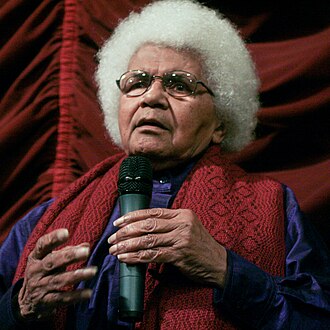
Portrait: Wikimedia Commons, Creative Commons
Sarah Ducados was born on the nineteenth of July 1929 at Condom, in the Gers department of south-western France, the daughter of a Guadeloupean father from Pointe-à-Pitre and a French mother of the Gers village community. She was raised in the rural French community of Condom and at the Guadeloupean immigrant community of the Toulouse suburbs.
She took the pen name Maldoror in the late 1940s in homage to the surrealist poem Les Chants de Maldoror of the Comte de Lautréamont — and worked across the early 1950s at Paris as a stage actress with the Compagnie des Griots, the principal Black French theatrical company of post-war France.
She co-founded with the Caribbean writers Aimé Césaire (placed in this archive) and Léopold Sédar Senghor (placed in this archive) and the Senegalese actor Robert Liensol the Compagnie des Griots at Paris in 1956 — the principal Black-French theatrical company of post-war Paris.
She studied film direction at the Gerasimov Institute of Cinematography at Moscow from 1961 to 1962 under the Soviet master Mark Donskoy — the first Black woman admitted to the Gerasimov Institute film-direction programme.
She was married in the early 1960s to the Angolan poet and anti-colonial militant Mário Pinto de Andrade — the principal founder of the Popular Movement for the Liberation of Angola (MPLA) — and lived with Andrade across the early 1960s at Algiers among the African anti-colonial movements in exile.
She directed her first short film, Monangambée, in 1968 — a study of the imprisonment and torture of an Angolan anti-colonial militant filmed in Algeria using the Algerian National Liberation Front cast and crew.
She directed her first feature film, Sambizanga, in 1972 — a one-hundred-and-three-minute reconstruction of the 1961 Angolan anti-colonial militant arrest of the Sambizanga district of Luanda, filmed in the Republic of the Congo with an Angolan exile cast. Sambizanga was the first feature film by a Black woman director of the African continent. It won the Tanit d'Or, the principal prize of the Carthage Film Festival, at the Carthage Film Festival of October 1972.
She directed approximately forty further short documentaries across the 1970s through the 2010s — including documentary portraits of Aimé Césaire, Léon-Gontran Damas, Ana Maria Cabral, and Léopold Sédar Senghor.
She died at Saint-Denis, Seine-Saint-Denis on the thirteenth of April 2020 of complications of COVID-19, at ninety.
She is honored here as the director of Sambizanga.
Keep a life of your own
Every family has a life like this one. Begin with yours.
Sources
- Sarah Maldoror - Wikipedia (en.wikipedia.org)
- Sarah Maldoror — Sambizanga: revolutionary filmmaker (Little White Lies) (lwlies.com)
- Sarah Maldoror (1929-2020) — IMDb (www.imdb.com)
The house names where it read; it does not send you off the house's own pages.
The proof
This life is kept with a public fingerprint anyone can check.
bafkreihheebktswovsrmotoeaps4nvhxkxrah2few2d5rwns6qqp27q7la
Something here is wrong, or missing? Write to info@honoredancestors.com with the source; a person at the house reads every letter, and a correction is made only from a source.