
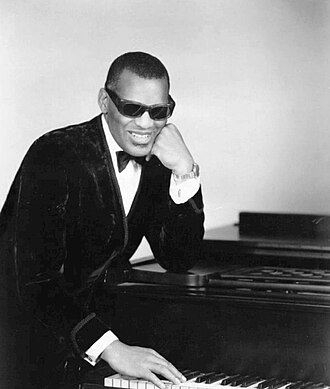
Ray Charles
1930 — 2004 · Singer, pianist, composer; the principal architect of the synthesis of gospel and rhythm-and-blues that produced the soul music of the post-war American century
Portrait: Wikimedia Commons, Creative Commons
Ray Charles Robinson was born on the twenty-third of September 1930 at Albany, Georgia, the elder of two sons of Bailey Robinson — an itinerant labourer who left the household before Ray's birth — and Aretha Williams Robinson, a domestic worker. The family moved when he was an infant to Greenville, Florida. He witnessed at five the drowning of his younger brother George in a household wash-tub — an episode he would across his life identify as the formative trauma of his childhood. He began to lose his sight around the age of five from probable juvenile glaucoma; by his seventh year he was totally blind.
He was sent at seven to the Florida School for the Deaf and Blind at St. Augustine. He learned at the school to read music in Braille, to play piano, alto saxophone, clarinet and organ, and to compose. His mother died when he was fifteen; he left St. Augustine the same year. He performed across Florida juke joints through 1947 and moved to Seattle in March 1948 at seventeen — the destination chosen because of its distance from the segregated music economies of the South. He formed there with Gossady McGee and Milton Garred the McSon Trio.
He shortened his name to Ray Charles to avoid confusion with the prizefighter Sugar Ray Robinson. He recorded with the McSon Trio for the Down Beat and Swing Time labels from 1949 to 1952 and signed with Atlantic Records in 1952. The 1955 single "I Got a Woman" — an arrangement of the Pentecostal hymn "It Must Be Jesus" with a secular lyric — produced the founding moment of the genre subsequently called soul music. The 1960 Atlantic studio album The Genius Hits the Road and the 1962 single "I Can't Stop Loving You" extended his synthesis to American country music and produced one of the principal cross-racial commercial-radio crossovers of his career.
He left Atlantic for ABC-Paramount in 1959 on terms that gave him ownership of his master tapes — the first major Black artist in American commercial-music history to retain ownership of his recordings. He founded his own record label, Tangerine Records, in 1962.
He received seventeen Grammy Awards across his career, was the founding inductee of the Rock and Roll Hall of Fame in 1986, and was awarded the Kennedy Center Honors in 1986 and the National Medal of Arts in 1993.
He died of liver failure at Beverly Hills on the tenth of June 2004, at seventy-three.
He is honored here as the architect of soul music.
Keep a life of your own
Every family has a life like this one. Begin with yours.
Sources
- Ray Charles | Biography, Music, Songs, Hit The Road Jack, Blind, & Facts | Britannica (www.britannica.com)
- Ray Charles - Wikipedia (en.wikipedia.org)
- Ray Charles (1930-2004) - New Georgia Encyclopedia (www.georgiaencyclopedia.org)
The house names where it read; it does not send you off the house's own pages.
The proof
This life is kept with a public fingerprint anyone can check.
bafkreibtdvh467fa5lzjrd6wvtucmou2jpxtryh2aoqocqriq4yzb4vlfq
Something here is wrong, or missing? Write to info@honoredancestors.com with the source; a person at the house reads every letter, and a correction is made only from a source.