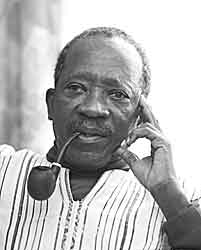
Ousmane Sembène
1923 — 2007 · Senegalese filmmaker and novelist; the founding figure of sub-Saharan African cinema
Portrait: Wikimedia Commons, Creative Commons
Ousmane Sembène was born on the first of January 1923 in Ziguinchor, in the Casamance region of what was then French-colonial Senegal. His formal schooling ended in 1936, when — by his own account, a young boy already chafing against colonial authority — he struck a French teacher who had struck him, and was expelled. He would carry that spirit of defiance for the rest of his life, teaching himself far more than any classroom had offered him.
As a young man he laboured as a fisherman, mason, and mechanic, was drafted into the French forces during the Second World War, and afterward settled in Marseille, where he worked the docks as a stevedore. There he read voraciously and rose within his trade union, and it was from the hold of that hard life that his first novel, Le Docker noir (The Black Docker), emerged in 1956. Largely self-taught in French, he went on to write Les Bouts de bois de Dieu (God's Bits of Wood, 1960), widely held to be his masterpiece.
Convinced that film could reach the millions who could not read, he turned to cinema around 1960. His 1966 film La Noire de… (Black Girl) is regarded as the first feature film by a sub-Saharan African director. In Mandabi (1968) he filmed in his own Wolof language; in Xala (1975), Ceddo (1977), Camp de Thiaroye (1988), and finally Moolaadé (2004) he indicted colonialism, corruption, and injustice while honouring the strength of ordinary Africans, above all women.
Ousmane Sembène died on the tenth of June 2007 in Dakar, remembered as the father of African cinema — a griot who gave his people their own image, and their own voice.
Keep a life of your own
Every family has a life like this one. Begin with yours.
Sources
- Ousmane Sembène - Wikipedia (en.wikipedia.org)
- Ousmane Sembène | Senegalese Filmmaker & Writer | Britannica (www.britannica.com)
- Ousmane Sembène | Biography | Research Starters | EBSCO Research (www.ebsco.com)
The house names where it read; it does not send you off the house's own pages.
The proof
This life is kept with a public fingerprint anyone can check.
bafkreihiixlhvf2plu7vuxz4ozcpmqm4phrn635yrkdk2wmnejlm2wqb74
Something here is wrong, or missing? Write to info@honoredancestors.com with the source; a person at the house reads every letter, and a correction is made only from a source.