
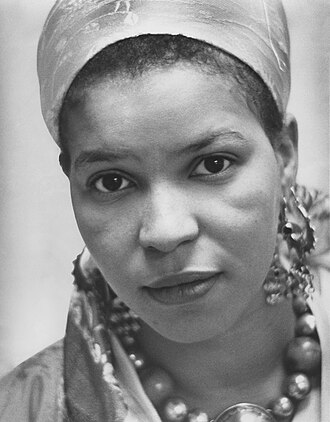
Ntozake Shange
1948 — 2018 · Playwright and poet; author of for colored girls who have considered suicide / when the rainbow is enuf; principal founder of the choreopoem as a theatrical form
Portrait: Wikimedia Commons, Creative Commons
Paulette Linda Williams was born on the eighteenth of October 1948 at Trenton, New Jersey, the eldest of four children of Paul T. Williams — an Air Force surgeon and amateur jazz drummer — and Eloise Owens Williams, a psychiatric social worker and Howard University literature graduate. The Williams household was professionally accomplished and culturally exceptional: Dizzy Gillespie, Miles Davis (placed in this archive), Chuck Berry and W. E. B. Du Bois (placed in this archive) were guests in the family home through her childhood. She was educated at the Trinity Episcopal School of Trenton and at Morristown Beard School in New Jersey before entering Barnard College in 1966 at seventeen.
She graduated cum laude from Barnard in 1970 with a degree in American studies, completed the master's at the University of Southern California in 1973, and moved to the Bay Area, where in 1971 she took the Zulu name Ntozake Shange — meaning she who comes with her own things and she who walks like a lion — at the suggestion of South African friends she had met at Berkeley. She taught women's studies at Sonoma State, at Mills and at the University of California Berkeley extension division from 1972 to 1975 while writing what would become her major work.
The choreopoem for colored girls who have considered suicide / when the rainbow is enuf was developed across the years 1974 and 1975 in collaboration with the dancer-choreographer Paula Moss and the female ensemble of the San Francisco Bay Area women's cultural movement. It opened in New York at Studio Rivbea in May 1975, moved to the New Federal Theatre in June 1976, to the Public Theater in October 1976, and to the Booth Theatre on Broadway on the fifteenth of September 1976 — making it the second play by a Black woman to reach Broadway. It received the 1977 Obie Award and Tony, Grammy and Emmy nominations.
She published across the following four decades nineteen plays, twenty-three volumes of poetry and prose, a children's book series, and the libretti for the 1985 musical setting of Toni Morrison's (placed in this archive) Sula and the 2008 musical Lift Every Voice. She suffered three strokes in 2004 and partial recovery thereafter sustained her writing through her sixties.
She died of natural causes at Bowie, Maryland, on the twenty-seventh of October 2018, at seventy.
She is honored here as the inventor of the choreopoem.
Keep a life of your own
Every family has a life like this one. Begin with yours.
Sources
- Ntozake Shange - Wikipedia (en.wikipedia.org)
- About Ntozake Shange | Academy of American Poets (poets.org)
- Ntozake Shange | Biography, Plays, Poems, Books, & Facts | Britannica (www.britannica.com)
The house names where it read; it does not send you off the house's own pages.
The proof
This life is kept with a public fingerprint anyone can check.
bafkreiaumlu7lj3ng5lvyqxhik44wqlkjctmkpgzsar7np4ipt64o7ouha
Something here is wrong, or missing? Write to info@honoredancestors.com with the source; a person at the house reads every letter, and a correction is made only from a source.