
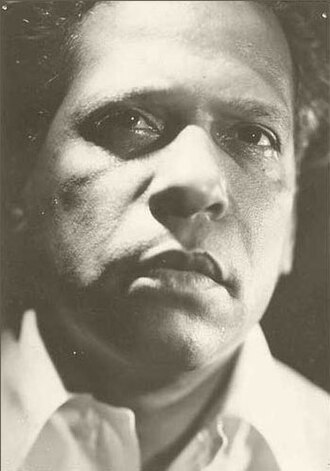
Nicolás Guillén
1902 — 1989 · National poet of Cuba; founder of the mulato literary movement and the principal Afro-Caribbean voice of twentieth-century Spanish-language poetry
Portrait: Wikimedia Commons, Creative Commons
Nicolás Cristóbal Guillén Batista was born on the tenth of July 1902 in Camagüey in central Cuba, the son of Nicolás Guillén Urra — a journalist, lieutenant in the war of independence and senator of the second republic — and Argelia Batista y Arrieta. His father was assassinated by government troops during the political crisis of 1917, when Guillén was fifteen. He completed his secondary education at the Instituto de Camagüey and began legal studies at the University of Havana before abandoning them for journalism.
He published his first verse collection in 1922 in the Modernista style that then dominated Spanish-American letters. His decisive aesthetic break came in 1930 with Motivos de son — eight short poems that for the first time in Cuban literature used the rhythms of the son cubano, the African-derived popular dance form of the Oriente, as the prosodic structure for serious verse. The 1931 follow-up Sóngoro cosongo deepened the technique. Cuban critics responded with a six-month controversy over whether Black popular form was admissible in high literature; Guillén's friend Federico García Lorca, in Havana that year, declared the question settled.
He joined the Cuban Communist Party in 1937 and spent twenty-two years in political exile across the Caribbean and Europe — including the long Spanish Civil War residency in Madrid alongside Pablo Neruda and Rafael Alberti. He returned to Havana in 1959 following the revolution and served until his death as the founding president of the National Union of Cuban Writers and Artists.
His mature volumes — West Indies Ltd. of 1934, El son entero of 1947, La paloma de vuelo popular of 1958 and El gran zoo of 1967 — established the synthesis of African-Caribbean popular form with the Spanish poetic line that is now the standard inheritance of all Latin American poetry. He died in Havana on the sixteenth of July 1989, six days after his eighty-seventh birthday.
He is honored here as the national poet of Cuba.
Keep a life of your own
Every family has a life like this one. Begin with yours.
Sources
- Nicolás Guillén - Wikipedia (en.wikipedia.org)
- Juan Nicolás Guillén Urra - EcuRed (www.ecured.cu)
- Nicolás Guillén | Cuban Poet & Activist | Britannica (www.britannica.com)
- Nicolás Guillén | Library of Congress (www.loc.gov)
The house names where it read; it does not send you off the house's own pages.
The proof
This life is kept with a public fingerprint anyone can check.
bafkreifpvr5uxyscs65ct4ett3tptmfwt7ay6ccnakmijsve5m4gfeakae
Something here is wrong, or missing? Write to info@honoredancestors.com with the source; a person at the house reads every letter, and a correction is made only from a source.