
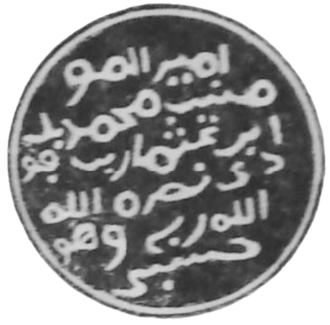
Muhammad Bello
1781 — 1837 · Second Sultan of Sokoto; consolidated and codified the Sokoto Caliphate
Portrait: Wikimedia Commons, Creative Commons
Muhammad Bello was born in 1781, the son of Usman dan Fodio (also placed in this archive) and Hauwa, his second wife. He was educated from early childhood by his father and the senior scholars of the Qadiriyya Sufi order — Arabic, Quranic exegesis, jurisprudence, history, and the political theory of Islamic governance.
He served as field commander of the early Sokoto jihad from 1804 (when he was twenty-three) through approximately 1810. He led the principal military campaigns that consolidated the Caliphate's northern and eastern frontiers. He founded the city of Sokoto itself in 1809 — the political capital that succeeded his father's earlier Degel — and oversaw its planning and construction.
He succeeded his father as Sultan of Sokoto in 1817 on Usman's death and ruled for the next twenty years until his own death in 1837. His reign was the consolidating period of the Caliphate: he codified administrative law along the Maliki school of Islamic jurisprudence, organized the provincial governorate (Amir) system through which the Caliphate's territory was governed, defended the Caliphate against repeated incursions by Bornu under Mohammed al-Kanemi, and conducted the systematic teaching program that produced two generations of Hausa-Fulani Islamic scholars.
He produced approximately eighty written works in Arabic and Fulfulde. His Infaq al-Maysur, a sustained history of the Sokoto jihad and the early Caliphate, remains the principal first-person source on the political history of the period. His treatises on military and civil law shaped Hausa-Fulani jurisprudence for the rest of the nineteenth century.
He died in Sokoto on the twenty-fifth of October 1837, age fifty-six. His brother Atiku Abdullahi succeeded him.
He is honored here as the Sultan whose codification turned his father's jihad into the largest African state of the nineteenth century.
Keep a life of your own
Every family has a life like this one. Begin with yours.
Sources
- Muhammed Bello - Wikipedia (en.wikipedia.org)
- Muhammad Bello | Biography | Research Starters | EBSCO Research (www.ebsco.com)
The house names where it read; it does not send you off the house's own pages.
The proof
This life is kept with a public fingerprint anyone can check.
bafkreierovezpwhhack7qtc6bul7u6kewxmxvwc6wyel7et3jbqinjuh7a
Something here is wrong, or missing? Write to info@honoredancestors.com with the source; a person at the house reads every letter, and a correction is made only from a source.