Miriam Makeba
1932 — 2008 · Singer; the first African artist to win a Grammy; Mama Africa
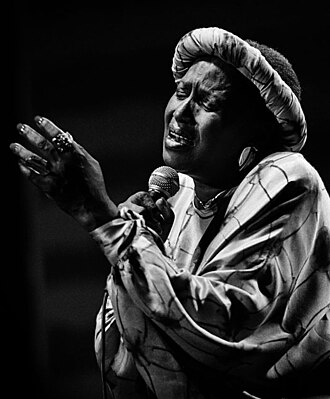
Portrait: Wikimedia Commons, Creative Commons
Zenzile Miriam Makeba was born on the fourth of March 1932 in Prospect Township, Johannesburg, the daughter of a Xhosa father, Caswell Makeba, and a Swazi mother, Christina. Her childhood carried the full weight of a country already hardening toward apartheid, yet from that ground rose one of the most luminous voices Africa has ever offered the world.
She began her professional career in 1953 with the Manhattan Brothers, recording the hit "Lakutshona Ilanga" and earning a national reputation. In 1956 she joined the all-woman group the Skylarks, weaving jazz with traditional South African melody. Her appearance in the anti-apartheid film "Come Back, Africa" carried her to Europe and America, where Harry Belafonte became her mentor. In 1966 she and Belafonte won the Grammy Award for Best Folk Recording for "An Evening with Belafonte/Makeba," making her the first African artist to win the honor.
Her voice was inseparable from her conscience. After testifying before the United Nations against apartheid, she was stripped of her South African citizenship and exiled for three decades, becoming stateless before nations across the world offered her passports. Songs such as "Pata Pata" and "The Click Song" carried her people's spirit into every hall she entered, and the world came to call her Mama Africa.
She returned home only after Nelson Mandela's release in 1990, and she sang until the very end, collapsing after a concert in Italy on the ninth of November 2008. Miriam Makeba turned exile into an anthem and grief into grace; her voice remains a homeland that no border could ever take from her people.
Keep a life of your own
Every family has a life like this one. Begin with yours.
Sources
- Miriam Makeba - Wikipedia (en.wikipedia.org)
- An Evening with Belafonte/Makeba - Wikipedia (en.wikipedia.org)
- Miriam Makeba | Biography, Songs, & Facts | Britannica (www.britannica.com)
The house names where it read; it does not send you off the house's own pages.
The proof
This life is kept with a public fingerprint anyone can check.
bafkreib3elpjeetpnl3z7nitu3fvia6xezbl7ik75a7vrwb3nsngburyya
Something here is wrong, or missing? Write to info@honoredancestors.com with the source; a person at the house reads every letter, and a correction is made only from a source.