
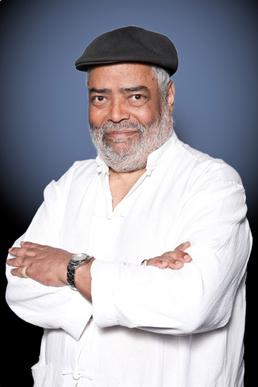
Med Hondo
1936 — 2019 · Atar-born Mauritanian filmmaker; director of Soleil Ô of 1970, West Indies of 1979, and Sarraounia of 1986; principal political-cinema auteur of post-colonial African cinema
Portrait: Wikimedia Commons, Creative Commons
Mohamed Abid Hondo — known to the world as Med Hondo — was born on the fourth of May 1936 in Aïn Ouled Beri Mathar, in the Atar region of the Adrar, in what was then French Mauritania. His father was Senegalese and his mother Mauritanian, and on his mother's side he carried Haratin ancestry, a lineage marked by the long shadow of caste slavery. From these desert beginnings he would rise to become the fiercest political voice in the cinema of post-colonial Africa.
In 1954 he left for Rabat to train as a cook, and in 1959 he crossed to France, where the wounds of exile and racism became the raw material of his art. He studied acting under Françoise Rosay, founded the Shango theatre troupe in 1966, and sustained himself for decades as a celebrated voice actor, lending his French voice to Eddie Murphy, Morgan Freeman, Sidney Poitier and others — labour that quietly financed his own uncompromising films.
His debut feature, Soleil Ô (1970), followed an African migrant broken by the racism of the French metropolis; it electrified Cannes and won the Golden Leopard at Locarno. He went on to build epic works of memory and resistance: West Indies (1979), a vast musical fresco of four centuries of Caribbean bondage and revolt, and Sarraounia (1986), the story of the Hausa queen who defied French colonial columns. He called his practice a "cinema of rupture," a weapon against the mechanisms of control and profit in the mainstream industry.
Across some fifteen films he insisted that collective memory was a battlefield and that Africans must tell their own histories. He died in Paris on the second of March 2019, aged eighty-two. We honor Med Hondo, who turned exile into vision and made of cinema an act of liberation.
Keep a life of your own
Every family has a life like this one. Begin with yours.
Sources
- Med Hondo - Wikipedia (en.wikipedia.org)
- Hondo, Med (1954–) | Encyclopedia.com (www.encyclopedia.com)
- Med Hondo | African Film Festival, Inc. (africanfilmny.org)
- Notebook Primer | Med Hondo | MUBI (mubi.com)
The house names where it read; it does not send you off the house's own pages.
The proof
This life is kept with a public fingerprint anyone can check.
bafkreiaxlv74m5q4dh33mne2wkthydfrfuxovrqjytxaroxisitdkxrnbm
Something here is wrong, or missing? Write to info@honoredancestors.com with the source; a person at the house reads every letter, and a correction is made only from a source.