Manu Dibango
1933 — 2020 · Cameroonian saxophonist, vibraphonist and composer; the principal francophone African jazz-funk artist of the twentieth century; composer of Soul Makossa
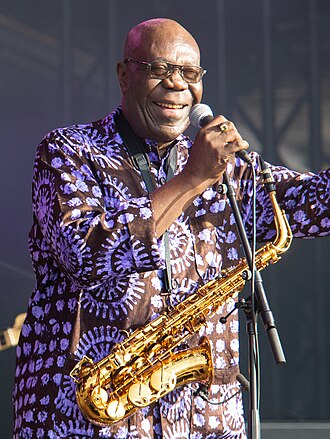
Portrait: Wikimedia Commons, Creative Commons
Emmanuel N'Djoké Dibango was born on the twelfth of December 1933 at Douala, French Cameroun, the son of Michel Manfred N'Djoké Dibango — a colonial civil servant of Yabassi ethnic origin — and Antoinette Dibango, a Duala-language schoolteacher and Protestant choir mistress. The Dibango household at the Akwa district of Douala was strictly Protestant; he sang from his sixth year in his mother's church choir and received his first piano instruction at eight from a Swiss missionary. He was sent at fifteen in 1949 to France for secondary education at the Lycée Saint-Germain-en-Laye in the Île-de-France.
He completed the baccalauréat at Saint-Germain in 1953 and enrolled at the Reims Conservatoire for piano studies. He shifted to the saxophone after attending in 1956 a Sidney Bechet concert at the Olympia in Paris. He left the Conservatoire in 1957 without taking the diploma and made his living for the next nine years on the European jazz-club circuit — at the Black Cat at Brussels, the Anneessens at Antwerp and the Living Room at Paris.
He travelled to Léopoldville (Kinshasa) in 1961 to play in the African Jazz orchestra of the Congolese rumba founder Joseph Kabasélé. He spent two years in the Congo as Kabasélé's saxophonist and arranger and returned to France in 1963 to begin his solo recording career.
He recorded the single Soul Makossa for the Fiesta label in May 1972 — written in five hours as the B-side of the official Cameroon Football Federation Africa Cup of Nations anthem, played at a New York discothèque later that year, repeatedly bootlegged across the American R&B market, and released in February 1973 by Atlantic Records as the first internationally successful single by a Black African artist. It reached number thirty-five on the Billboard Hot 100. The opening phrase of Soul Makossa was subsequently incorporated by Michael Jackson (placed in this archive) into Wanna Be Startin' Somethin' on the 1982 Thriller album; a settled 2009 lawsuit recognised Dibango's authorship.
He produced across the following four decades over forty studio albums.
He died of complications of COVID-19 at Melun, France, on the twenty-fourth of March 2020, at eighty-six.
He is honored here as the composer of Soul Makossa.
Keep a life of your own
Every family has a life like this one. Begin with yours.
Sources
- Manu Dibango - Wikipedia (en.wikipedia.org)
- Manu Dibango | Encyclopedia.com (www.encyclopedia.com)
The house names where it read; it does not send you off the house's own pages.
The proof
This life is kept with a public fingerprint anyone can check.
bafkreidpnrfdavchpaw2xoxxtnb4lghwz6l73277jpncxrmdl4lrbt4mpa
Something here is wrong, or missing? Write to info@honoredancestors.com with the source; a person at the house reads every letter, and a correction is made only from a source.