
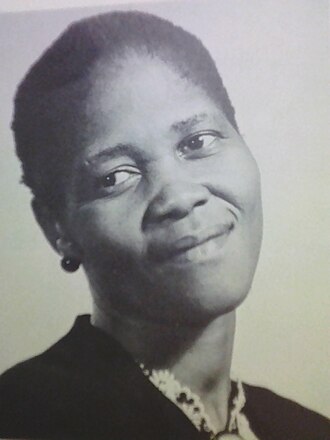
Lilian Ngoyi
1911 — 1980 · Anti-apartheid organizer; led the 1956 Women's March on the Union Buildings in Pretoria
Portrait: Wikimedia Commons, Creative Commons
Lilian Masediba Ngoyi was born on Bloed Street in Pretoria, South Africa, on the twenty-fifth of September 1911, daughter of Isaac Matabane, who worked the mines, and Annie, who took in washing. She trained as a nurse before circumstances turned her toward the garment industry; married young to John Ngoyi and widowed by 1937, she worked as a machinist in a clothing factory from 1945 to 1956. On the factory floor she joined the Garment Workers' Union and emerged as one of its most compelling voices, discovering the gift for oratory that would one day move thousands.
In 1952 she stepped into formal resistance, joining the African National Congress Women's League and taking part in the Defiance Campaign. Her rise was swift: elected president of the Women's League in 1953, she helped found the Federation of South African Women in 1954 as a founding vice-president, and in 1955 she journeyed abroad — traveling without official permission — to address the World Congress of Mothers in Lausanne, Switzerland. In December 1956 she became the first woman elected to the ANC's National Executive Committee.
On the ninth of August 1956, Ngoyi and Helen Joseph led an estimated twenty thousand women to the Union Buildings in Pretoria to protest the extension of the pass laws to African women. Prime Minister Strijdom would not receive them; the bundled petitions were left at his door. She called the vast crowd into thirty minutes of resolute silence — a moment of disciplined defiance that remains the largest women's demonstration in South African history and is now honored each year as Women's Day — and then the song rose that named the day: Wathint' abafazi, wathint' imbokodo — you strike a woman, you strike a rock.
For her leadership she paid dearly. Named among the 156 accused in the Treason Trial of 1956, she was acquitted in 1960, then subjected to years of banning orders confining her to Orlando, Soweto — imposed in 1962, renewed into the 1970s — and detention, including seventy-one days in solitary confinement. Confined and silenced by the state, she died on the thirteenth of March 1980, still under the ban, never having surrendered her dignity or her cause. May the mother of the march be remembered as long as the silence she commanded echoes.
Keep a life of your own
Every family has a life like this one. Begin with yours.
Sources
- Lillian Ngoyi - Wikipedia (en.wikipedia.org)
- Ngoyi, Lilian (1911–1980) | Encyclopedia.com (www.encyclopedia.com)
- Lilian Ngoyi: an heroic South African woman whose story hasn't been fully told | The Conversation (theconversation.com)
- Lillian Masediba Ngoyi — South African History Online (sahistory.org.za)
The house names where it read; it does not send you off the house's own pages.
The proof
This life is kept with a public fingerprint anyone can check.
bafkreigrbpdvt3b2xhciwtjd6acpvddrqdcavo6zfilwn4o5vxqqqnkrru
Something here is wrong, or missing? Write to info@honoredancestors.com with the source; a person at the house reads every letter, and a correction is made only from a source.