
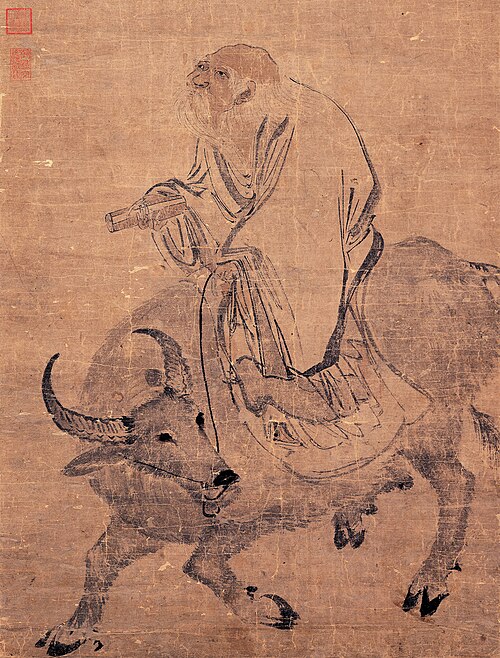
Laozi
c. 6th century BCE · East Asia · Ancient
Chinese sage traditionally regarded as the founder of Taoism.
Portrait: Zhang Lu · Public domain · via Wikimedia Commons
- Birthplace
- East Asia
- Known as
- Chinese sage traditionally regarded as the founder of Taoism.
Laozi — the name means simply “the Old Master” — stands at the source of Taoism, one of the great currents of Chinese thought. Tradition places him in the sixth century BCE as an archivist of the Zhou court, an elder whom even Confucius is said to have sought out; but the man himself is half legend, and modern scholars regard much of his story as later invention.
To him is attributed the Tao Te Ching, the “Classic of the Way and its Virtue” — some five thousand characters of spare, paradoxical verse on living in accordance with the Tao, the underlying way of things. Its counsel of humility, yielding, and effortless action has been read for more than two thousand years.
By legend, weary of the world’s corruption, he rode west on an ox; a border guard begged him to leave his wisdom behind, and he wrote the book in a single sitting before vanishing from history. Whether one man or many hands composed it, the text became foundational.
In religious Taoism he was later revered as a god, a personification of the Tao itself. Honored among the Great Ones of every civilization; kept here so the memory is never lost.
Keep a life of your own
Every family has a life like this one. Begin with yours.
Sources
- Stanford Encyclopedia of Philosophy — Laozi (plato.stanford.edu)
- Encyclopædia Britannica — Laozi (www.britannica.com)
- Wikipedia — Laozi (en.wikipedia.org)
The house names where it read; it does not send you off the house's own pages.
The proof
This life is kept with a public fingerprint anyone can check.
bafkreidte67ydn5bcey5ycwnnws3ug7yq6hbyutn2thb66lvqmucl2evpi
Something here is wrong, or missing? Write to info@honoredancestors.com with the source; a person at the house reads every letter, and a correction is made only from a source.