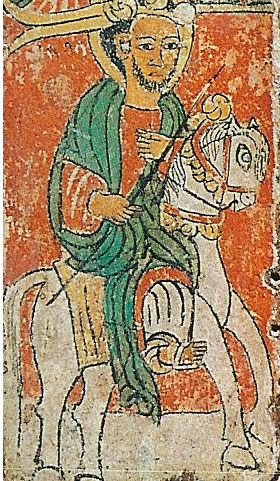
King Lalibela
c. 1162 — 1221 · Zagwe king of Ethiopia; commissioner of the eleven monolithic rock-hewn churches that bear his name and remain in continuous Christian worship eight centuries after his death
Portrait: Wikimedia Commons, Creative Commons
Gebre Mesqel Lalibela was born around 1162 at Roha in the highlands of present-day northern Ethiopia, the youngest son of King Jan Seyum of the Zagwe dynasty of Lasta. The Zagwe — an Agaw-speaking dynasty that had succeeded to the throne of the Aksumite Empire around 1137 — had moved the imperial capital from Aksum south to Roha. The hagiographical Gadl that preserves Lalibela's life records that at his birth a swarm of bees surrounded him without harm; his mother named him in consequence Lalibela — the one to whom bees attend his sovereignty.
He survived an attempted poisoning by his half-brother King Harbay in his youth and during the long recovery received, according to the Gadl, a vision of a new Jerusalem to be cut from the living rock of his highland capital. He acceded to the throne around 1185 after the abdication of Harbay.
Across the following twenty-four years he supervised the construction of the eleven monolithic rock-hewn churches that now bear his name and constitute the single most consequential architectural undertaking of medieval Ethiopian civilisation. The churches — Bete Medhane Alem, Bete Maryam, Bete Golgotha, Bete Mikael, Bete Gabriel-Rufael, Bete Mercurios, Bete Amanuel, Bete Abba Libanos, Bete Lehem, Bete Giyorgis and the cluster of Bete Denagel — were excavated downward from the surrounding rock, the surrounding stone removed to leave each freestanding, and the interior chambers carved within. Bete Giyorgis, the most architecturally complete, is cut to the form of an equilateral cross sunk thirty metres into the basalt.
The capital was renamed Lalibela after his death and Jerusalem was symbolically transferred to it after the fall of the Crusader kingdom in 1187. The eleven churches remain a centre of Ethiopian Orthodox pilgrimage to the present day and were inscribed by UNESCO on the World Heritage List in 1978.
He is honored here as the architect-king of Ethiopia.
Keep a life of your own
Every family has a life like this one. Begin with yours.
Sources
- Gebre Mesqel Lalibela - Wikipedia (en.wikipedia.org)
- Lalibela | Biography | Research Starters | EBSCO Research (www.ebsco.com)
- Lalibela | Encyclopedia.com (www.encyclopedia.com)
The house names where it read; it does not send you off the house's own pages.
The proof
This life is kept with a public fingerprint anyone can check.
bafkreidocwi3cvdvivkxcjeflstlqyeeb76c56qg46he5xthdzvyha4k6q
Something here is wrong, or missing? Write to info@honoredancestors.com with the source; a person at the house reads every letter, and a correction is made only from a source.