
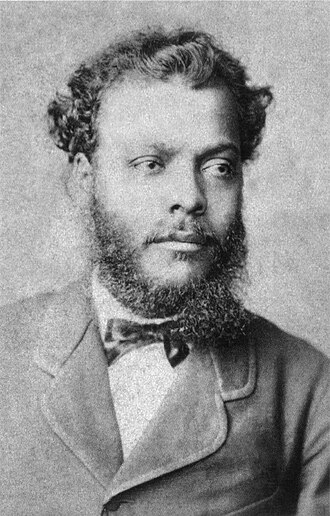
José do Patrocínio
1853 — 1905 · Abolitionist journalist whose Gazeta da Tarde and Cidade do Rio campaigns were decisive in the final Brazilian abolition of 1888
Portrait: Wikimedia Commons, Creative Commons
José Carlos do Patrocínio was born on 9 October 1853 in Campos dos Goytacazes, in the province of Rio de Janeiro. His father, João Carlos Monteiro, was a white Catholic priest and planter; his mother, Justina Maria do Espírito Santo, was an enslaved Black woman of African descent. Born into that fracture between the master's house and the enslaved quarters, Patrocínio carried the cause of freedom in his very origin, and he would spend his life making a nation reckon with it.
As a young man he made his way to Rio de Janeiro, laboring for a time and studying pharmacy before turning to the press, where his true weapon lay. Through the 1870s he wrote for papers including the Gazeta de Notícias, and after 1881 he took command of the Gazeta da Tarde, turning it into the foremost antislavery journal in Brazil. In 1887 he founded and directed A Cidade do Rio, a platform for his fiery editorials and unbending abolitionist voice.
A powerful orator and organizer, Patrocínio helped found the Confederação Abolicionista and drove regional campaigns that freed whole districts ahead of the law — Ceará in 1882, his native Campos in 1885, the port of Santos in 1886. His relentless agitation helped force the final abolition of Brazilian slavery on 13 May 1888, earning him the name Tigre da Abolição, the Tiger of Abolition.
He later helped found the Brazilian Academy of Letters, holding its twenty-first chair from 1897 until his death in Rio de Janeiro in January 1905. May the Tiger of Abolition be honored — a son of an enslaved mother whose pen helped break a nation's chains.
Keep a life of your own
Every family has a life like this one. Begin with yours.
Sources
- José do Patrocínio - Wikipedia (en.wikipedia.org)
- Patrocínio, José do (1853–1905) | Encyclopedia.com (www.encyclopedia.com)
- José do Patrocínio | Intelectuais Negros (Universidade Federal Fluminense) (www.historia.uff.br)
The house names where it read; it does not send you off the house's own pages.
The proof
This life is kept with a public fingerprint anyone can check.
bafkreiepj762mpajf2q3jru4ywsbshfsjt3m7ylh32bh45ds4epwzhr4xm
Something here is wrong, or missing? Write to info@honoredancestors.com with the source; a person at the house reads every letter, and a correction is made only from a source.