Horace Silver
1928 — 2014 · Pianist-composer of hard bop's gospel soul; co-founder of the Jazz Messengers; Song for My Father; Blue Note's longest-tenured artist
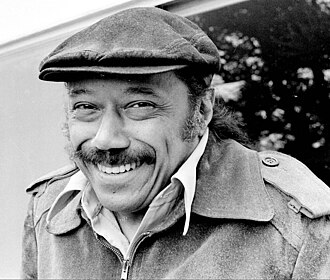
Portrait: Wikimedia Commons, Creative Commons
Horace Silver was born on the second of September 1928 at Norwalk, Connecticut — his father, John Tavares Silver, an immigrant from Maio in Cape Verde whose folk melodies would surface decades later in his son's most famous song; his mother a Connecticut church singer. In 1950 Stan Getz played Hartford with a local trio behind him — Silver at the piano — and liked what he heard enough to hire all three; Silver's recording life began that December.
New York and Blue Note followed: a 1952 Lou Donaldson session opened the door, and when a date fell free, Alfred Lion gave the young pianist his own trio debut — the start of a twenty-eight-year run, 1952 to 1979, the longest tenure of any artist in Blue Note's history. In September 1954 he gathered the quintet — Silver, Art Blakey, Hank Mobley, Kenny Dorham, Doug Watkins — that took the name the Jazz Messengers as a five-man cooperative in 1955 and poured gospel and blues back into modern jazz; when Silver left in 1956 to lead his own quintet, Blakey kept the name and Silver kept the sound.
The songs became the common book: The Preacher (1955), which Alfred Lion thought too old-timey until Silver and Blakey insisted; Señor Blues; Sister Sadie; Filthy McNasty; and in 1964, with the Cape Verdean lilt his father had carried across the ocean, Song for My Father — whose opening vamp Steely Dan famously borrowed for "Rikki Don't Lose That Number." The Blue Mitchell–Junior Cook quintet of 1958-64 was hard bop's finishing school; the National Endowment for the Arts named him a Jazz Master in 1995.
His later decades ran his own Silveto imprint through a spiritual turn, then Columbia, Impulse!, and Verve. He died at New Rochelle, New York, on the eighteenth of June 2014, at eighty-five. Honored be Horace Silver, who taught modern jazz to say amen.
Keep a life of your own
Every family has a life like this one. Begin with yours.
Sources
- Horace Silver — Wikipedia (en.wikipedia.org)
- Horace Silver — bluenote.com (www.bluenote.com)
- Horace Silver — arts.gov (www.arts.gov)
The house names where it read; it does not send you off the house's own pages.
The proof
This life is kept with a public fingerprint anyone can check.
bafkreianp55uqg5ludam4qnfbqe33dbkinczwvq3yb6ubrsmyqq54bqp3e
Something here is wrong, or missing? Write to info@honoredancestors.com with the source; a person at the house reads every letter, and a correction is made only from a source.