George Walker
1922 — 2018 · Washington, D.C.-born composer and pianist; the first African American composer to win the Pulitzer Prize in Music — for Lilacs in 1996
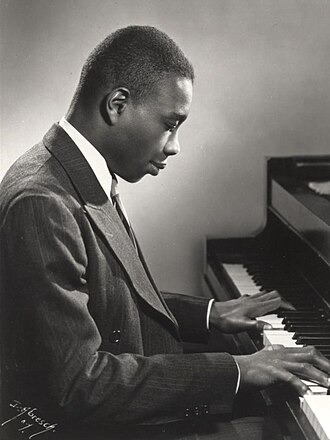
Portrait: Wikimedia Commons, Creative Commons
George Theophilus Walker was born on the twenty-seventh of June 1922 in Washington, D.C., the son of George Theophilus Walker Sr. — a Jamaican-born physician who emigrated from Kingston and put himself through Temple University's medical school — and Rosa King Walker, who gave her son his first piano lessons at the age of five. In a segregated capital, his was a household of discipline and aspiration, and the boy took to the keyboard with a seriousness that would define his life.
His gifts carried him swiftly. He entered Oberlin Conservatory at fourteen and then the Curtis Institute of Music, where he studied piano with Rudolf Serkin, chamber music with William Primrose and Gregor Piatigorsky, and composition with Rosario Scalero. In 1945 he became one of the first Black graduates of Curtis, made his debut at New York's Town Hall, and appeared as soloist with the Philadelphia Orchestra. In 1955 he became the first Black recipient of a doctorate from the Eastman School of Music.
Walker built a distinguished life as both performer and teacher, breaking barriers as an early Black tenured faculty member at Smith College and, for many years, at Rutgers University. Across his career he composed nearly one hundred works — symphonies, concertos, chamber pieces, and song cycles — among them the widely admired Lyric for Strings. In 1996 he became the first African American composer to win the Pulitzer Prize in Music, honored for Lilacs, a meditation for voice and orchestra set to Walt Whitman's elegy for Abraham Lincoln.
Elected to the American Academy of Arts and Letters and inducted into the American Classical Music Hall of Fame, George Walker died on the twenty-third of August 2018 in Montclair, New Jersey, at ninety-six. He opened doors that had been closed, and left behind a body of music equal to the dignity of the man. May his name be spoken with honor.
Keep a life of your own
Every family has a life like this one. Begin with yours.
Sources
- George Walker (composer) — Wikipedia (en.wikipedia.org)
- George Walker — Encyclopedia.com (www.encyclopedia.com)
- Bio — George Walker (official site) (www.georgetwalkercomposer.org)
- Lilacs, for voice and orchestra, by George Walker — The Pulitzer Prizes (www.pulitzer.org)
The house names where it read; it does not send you off the house's own pages.
The proof
This life is kept with a public fingerprint anyone can check.
bafkreidcpwyz7agzneysm7f6e247tjsikkc6wmumqbn23g2cks5giexfgm
Something here is wrong, or missing? Write to info@honoredancestors.com with the source; a person at the house reads every letter, and a correction is made only from a source.