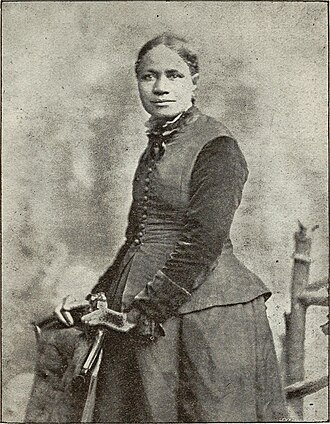
Frances E. W. Harper
1825 — 1911 · Celebrated as the most popular African American poet before Paul Laurence Dunbar; co-founder of the National Association of Colored Women
Portrait: Wikimedia Commons, Creative Commons
Frances Ellen Watkins Harper was born free in Baltimore, Maryland, on the twenty-fourth of September 1825. Orphaned at the age of three, she was raised by her uncle William Watkins, a free Black abolitionist, educator, and minister, and was schooled at his Watkins Academy for Negro Youth. There she absorbed the twin disciplines that would shape her life: a rigorous command of language and an unbending conviction that a people's dignity must be defended in public.
In 1850 she went west to teach, the first woman on the faculty of Union Seminary, the AME school near Columbus, Ohio. She published her first known collection, Forest Leaves, around 1845, and in 1854 her Poems on Miscellaneous Subjects — carrying a preface attributed to William Lloyd Garrison — which sold some ten thousand copies in its first years and made her, many scholars hold, the most popular African American poet before Paul Laurence Dunbar. That same year, from her first address at New Bedford, she took to the anti-slavery circuit in earnest, engaged as a traveling lecturer by the anti-slavery society of Maine, with a rare eloquence that drew crowds and quiet respect. Her 1859 short story "The Two Offers" is regarded as among the first published by a Black woman.
In 1860 she married Fenton Harper in Ohio; their daughter Mary was born two years later, and by 1864 she was widowed and returned to the platform. After emancipation she carried her voice into Reconstruction, traveling the South to teach and to speak among the newly freed. Her Moses: A Story of the Nile (1869) retold deliverance in verse, and her 1892 novel Iola Leroy stands as one of the earliest novels published by an African American woman. She labored as well within the temperance movement and the struggle for women's suffrage, insisting that the freedom of her people and the rights of women were one cause.
In 1896 she helped found the National Association of Colored Women and served as one of its vice presidents. Frances Ellen Watkins Harper died in Philadelphia on the twenty-second of February 1911. She gave her whole life to the word and to the worth of her people, and the archive keeps her name in honor.
Keep a life of your own
Every family has a life like this one. Begin with yours.
Sources
- Frances Ellen Watkins Harper - Wikipedia (en.wikipedia.org)
- About Frances Ellen Watkins Harper | Academy of American Poets (poets.org)
- Frances E.W. Harper | African-American Author & Social Reformer | Britannica (www.britannica.com)
- Frances Ellen Watkins Harper — Colored Conventions Project (coloredconventions.org)
The house names where it read; it does not send you off the house's own pages.
The proof
This life is kept with a public fingerprint anyone can check.
bafkreia6t44q7n37j46yvun7vymclixaxnzjvymciqft5bv46f2ax36go4
Something here is wrong, or missing? Write to info@honoredancestors.com with the source; a person at the house reads every letter, and a correction is made only from a source.