Eric Williams
1911 — 1981 · Trinidadian historian and Prime Minister; author of Capitalism and Slavery
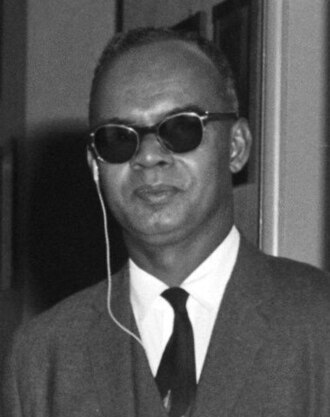
Portrait: Wikimedia Commons, Creative Commons
Eric Eustace Williams was born in Port of Spain, Trinidad, on the twenty-fifth of September 1911, the eldest child of Thomas Henry Williams, a junior post office official, and Eliza Frances Boissière. A brilliant student at Queen's Royal College, he won the coveted Island Scholarship that carried him to St Catherine's Society at the University of Oxford, where he took a first-class honours degree in history in 1935 and completed his doctorate (D.Phil.) in 1938.
His Oxford dissertation, "The Economic Aspects of the Abolition of the Slave Trade and West Indian Slavery," matured into "Capitalism and Slavery," published in 1944 while he taught at Howard University, where he rose to full professor. In it he argued that the profits of enslaved African labour helped finance Britain's Industrial Revolution, and that abolition owed as much to shifting economic interest as to moral awakening — a thesis that reshaped the study of slavery and empire and still stirs scholarly debate today. From 1944 he also served the Caribbean Commission at Port of Spain, as secretary of its research council and, from 1948, deputy chairman.
Returning fully to the Caribbean, Williams founded the People's National Movement on the fifteenth of January 1956 — his open-air lectures in Woodford Square, "the University of Woodford Square," had already made the public square his classroom — and led it to power that same year. He served as Chief Minister and then Premier, and on the thirty-first of August 1962 became the first Prime Minister of an independent Trinidad and Tobago. Nicknamed "the Father of the Nation," he guided the young country through education reform, social investment, and economic development for the rest of his life — and still he wrote, his autobiography Inward Hunger (1969) and From Columbus to Castro (1970) among the fruits of the office years.
He held that office until his death at St Ann's, Port of Spain, on the twenty-ninth of March 1981, after illness borne of the diabetes he had long carried. Scholar and statesman, he taught a people to read their own history without flinching, and to carry it with pride. May his name endure among the honored.
Keep a life of your own
Every family has a life like this one. Begin with yours.
Sources
- Eric Williams - Wikipedia (en.wikipedia.org)
- Eric Eustace Williams [c. 1911-1981] | Oxford and Empire Network, University of Oxford (oxfordandempire.web.ox.ac.uk)
- Eric Williams | Britannica (www.britannica.com)
The house names where it read; it does not send you off the house's own pages.
The proof
This life is kept with a public fingerprint anyone can check.
bafkreigbipwtfgup2hajfyol2qun5jnwwiuffpjcbbji4dypkixu7zdu2y
Something here is wrong, or missing? Write to info@honoredancestors.com with the source; a person at the house reads every letter, and a correction is made only from a source.