Dambudzo Marechera
1952 — 1987 · Rusape-born Zimbabwean novelist and poet; author of the 1978 novella The House of Hunger; co-winner of the 1979 Guardian First Book Award
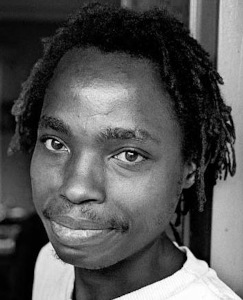
Portrait: Wikimedia Commons, Creative Commons
Charles William Tambudzai Dambudzo Marechera was born on the fourth of June 1952 at the Vengere township of Rusape, in the eastern highlands of Southern Rhodesia, the son of Isaac Marechera — a mortuary attendant of the Rusape General Hospital — and Masvotwa Venenzia Marechera, a domestic worker. His father was struck and killed by a car on the Rusape road in 1966, an event from which Marechera never recovered.
He was raised in the township and educated at the St. Augustine’s Mission School at Penhalonga on a Catholic missionary scholarship — completing the school certificate in 1971 — and at the University College of Rhodesia at Salisbury in 1972, where he took the first year of an English literature programme before being expelled in 1973 for organising student protests against the Rhodesia Front régime.
He took up a Rhodes-like Junior Open Scholarship to New College, Oxford in 1974 in English literature — among the first Black Zimbabwean students at Oxford — but was sent down in 1976 for setting fire to the college after a confrontation with the master, the philosopher Alan Bullock.
He lived for the following four years in a series of London squats, bed-and-breakfast establishments and short-term shelters in Camden Town and the East End — sleeping in some weeks in Hampstead Heath — and wrote across the same period the manuscript of the novella collection The House of Hunger.
The House of Hunger was published at the London house Heinemann African Writers Series in 1978 — the title novella the surreal chronicle of a single day in a Rhodesian township from the point of view of an unnamed adolescent. The book was awarded the 1979 Guardian First Book Award, shared with the Indian novelist Neville Maxwell — the first joint African winner of the prize and the youngest writer ever to win it at twenty-six.
He returned to Zimbabwe at independence in 1982 after eight years of exile and lived the remaining five years of his life in central Harare, predominantly on park benches near the Cecil Square and the Harare Gardens.
He published in 1980 the novel Black Sunlight and in 1984 the novel Mindblast — the latter the chronicle of his own homelessness in the central Harare of the early Mugabe period.
He died at Harare on the eighteenth of August 1987 of pulmonary complications of AIDS, at thirty-five.
He is honored here as the author of The House of Hunger.
Keep a life of your own
Every family has a life like this one. Begin with yours.
Sources
- Dambudzo Marechera - Wikipedia (en.wikipedia.org)
- The projected versions of Dambudzo Marechera - Africa Is a Country (africasacountry.com)
The house names where it read; it does not send you off the house's own pages.
The proof
This life is kept with a public fingerprint anyone can check.
bafkreiax7q6rjh65zac5hi7fkxcnzh4zeahrvav6nrst6ov3bhrtbsi5di
Something here is wrong, or missing? Write to info@honoredancestors.com with the source; a person at the house reads every letter, and a correction is made only from a source.