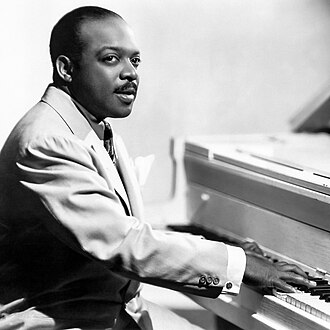
Count Basie
1904 — 1984 · Bandleader of the Kansas City swing; One O'Clock Jump; among the first two Black artists ever to win a Grammy
Portrait: Wikimedia Commons, Creative Commons
William James Basie was born on the twenty-first of August 1904 at Red Bank, New Jersey — his father a coachman, his mother a laundress who paid twenty-five cents a lesson for the piano. Harlem finished the schooling: Fats Waller taught him the organ, the clubs taught him the trade, and the vaudeville circuits carried him west until 1927 stranded him in Kansas City, playing for silent pictures at the Eblon Theater.
Kansas City made him. Walter Page's Blue Devils, then Bennie Moten's great orchestra; and when Moten died in the spring of 1935, Basie gathered the best of that lineage — Page, Jo Jones, Lester Young, Jimmy Rushing — into a nine-piece band at the Reno Club. One winter night in 1935-36, the critic John Hammond, parked outside a Chicago hotel, caught the band's broadcast from the experimental Kansas City station W9XBY on his car radio, drove to hear them, and wrote the world a letter. By Christmas 1936 the band stood in New York's Roseland Ballroom.
What followed was the swing itself: One O'Clock Jump (1937), Jumpin' at the Woodside (1938), the All-American Rhythm Section with Freddie Green's guitar breathing under everything, Lester Young and Herschel Evans trading tenors. He disbanded once in the lean year of 1950, ran small groups, and reformed the sixteen-piece "New Testament" band in 1952 — April in Paris, The Atomic Mr. Basie, the Sinatra and Ella collaborations. At the first Grammy ceremony in 1959 he took two awards — among the first two Black artists ever to win a Grammy, and the first African American man to do so — and the Kennedy Center honored him in 1981.
He died of pancreatic cancer at Hollywood, Florida, on the twenty-sixth of April 1984, at seventy-nine, the Count of an American music. Honored be Count Basie, who said more with one note than most bands say all night.
Keep a life of your own
Every family has a life like this one. Begin with yours.
Sources
- Count Basie — countbasie.rutgers.edu (countbasie.rutgers.edu)
- Count Basie — Wikipedia (en.wikipedia.org)
- Count Basie — grammymuseum.org (grammymuseum.org)
The house names where it read; it does not send you off the house's own pages.
The proof
This life is kept with a public fingerprint anyone can check.
bafkreib5s44utrcslhbjhvaggclsiesndokboeol4f2ckj6saarjovzvme
Something here is wrong, or missing? Write to info@honoredancestors.com with the source; a person at the house reads every letter, and a correction is made only from a source.