Bob Marley
1945 — 1981 · The principal Jamaican exponent of reggae music; founder of The Wailers; the most widely-circulated Black-Atlantic artist of the second half of the twentieth century
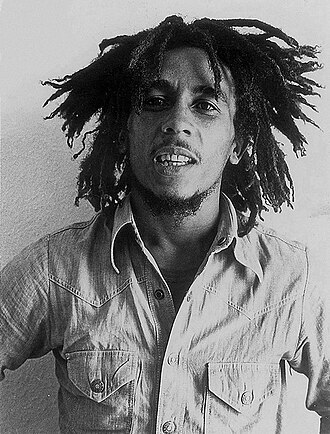
Portrait: Wikimedia Commons, Creative Commons
Robert Nesta Marley was born on the sixth of February 1945 at the rural farming village of Nine Mile in the parish of Saint Ann, Jamaica, the son of Cedella Booker — a Jamaican Black teenage mother of African-Akan descent — and Captain Norval Sinclair Marley, a white Jamaican of English-and-Syrian descent and an officer in the British colonial-military command at Jamaica. His parents were not married; his father left the household before his birth and saw the child only intermittently across his childhood. He was raised by his mother and his maternal grandfather Omeriah Malcolm at Nine Mile.
He moved to Kingston with his mother in 1953 at eight and to the impoverished Trench Town district of West Kingston in 1959. He met at Trench Town in 1962 the singers Bunny Livingston and Peter Tosh; the three formed in 1963 the vocal trio The Wailing Wailers. The Wailing Wailers recorded their first sessions for the Studio One label of Clement "Coxsone" Dodd at Brentford Road and produced across the years 1964 to 1966 the rocksteady singles — "Simmer Down," "Rude Boy," "One Love" — that placed the group at the centre of the post-ska Jamaican popular music.
He moved to Wilmington, Delaware, in February 1966 for three months to work at the DuPont Hotel as a porter — his mother had remarried and emigrated to the United States. He returned to Kingston in October 1966 and across the next four years deepened his commitment to the Rastafari faith — to which he had been introduced in his late teens by his Trench Town circle.
The Wailing Wailers were reorganised as The Wailers in 1971. The group signed with Island Records in 1972 and released the album Catch a Fire in April 1973 — the first reggae album produced for the international market with the recording quality and packaging of a major-label rock release. The international career thus opened produced across the following nine years the albums Burnin' (1973), Natty Dread (1974), Live! (1975), Rastaman Vibration (1976), Exodus (1977), Kaya (1978), Survival (1979) and Uprising (1980).
The 1976 attempt on his life — the gunmen who attacked the Hope Road residence on the third of December 1976 in advance of the Smile Jamaica peace concert — produced his eighteen-month withdrawal to London and the recording of the Exodus album.
He was diagnosed with acral lentiginous melanoma in July 1977. He died at the Cedars of Lebanon Hospital at Miami on the eleventh of May 1981, at thirty-six.
He is honored here as the principal exponent of reggae.
Keep a life of your own
Every family has a life like this one. Begin with yours.
Sources
- Bob Marley - Wikipedia (en.wikipedia.org)
- Bob Marley Biography - Biography.com (www.biography.com)
- Bob Marley | Rock & Roll Hall of Fame (www.rockhall.com)
The house names where it read; it does not send you off the house's own pages.
The proof
This life is kept with a public fingerprint anyone can check.
bafkreie6qjwj3n2fero4duluqmpveukseo7r3eqljr2uk4memvfq4urtla
Something here is wrong, or missing? Write to info@honoredancestors.com with the source; a person at the house reads every letter, and a correction is made only from a source.