
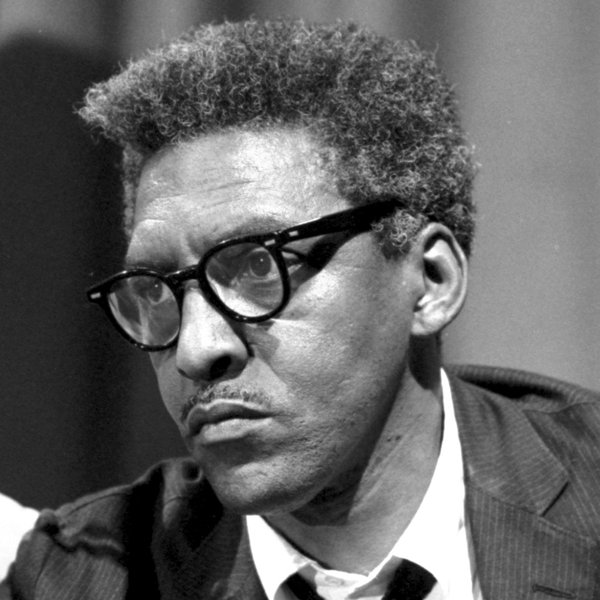
Bayard Rustin
1912 — 1987 · Chief strategist of the March on Washington for Jobs and Freedom; pioneer Quaker pacifist and architect of nonviolent direct action in the American civil-rights movement
The Pennsylvania-born organizer who taught Martin Luther King the discipline of nonviolence — and built the day on which I Have a Dream was spoken.
Portrait: Wikimedia Commons, Creative Commons
Bayard Taylor Rustin was born on the seventeenth of March 1912 at West Chester, Pennsylvania, the youngest of nine children raised by his grandparents Janifer and Julia Davis Rustin. He was raised — without knowing the truth of his parentage until adolescence — as the youngest sibling of his birth mother Florence Rustin, who was sixteen at his birth. His Quaker grandmother Julia Davis Rustin — a member of the West Chester Friends Meeting and an active NAACP organiser — gave him the dual political and spiritual formation that defined his career: Quaker pacifism and Black activism intertwined.
He moved to Harlem in 1937, joined the Young Communist League briefly, broke with it in 1941 over the abandonment of the campaign against military segregation following the German invasion of the Soviet Union, and entered the Fellowship of Reconciliation as a field secretary the same year. He was imprisoned for twenty-eight months from 1944 to 1946 as a Quaker conscientious objector to the Second World War. In 1947 he organised with George Houser of CORE the Journey of Reconciliation — the prototype Freedom Ride that tested the Morgan v. Virginia desegregation decision on interstate buses and produced his second imprisonment, on a North Carolina chain gang.
He travelled to India in 1948 as the guest of the Constructive Programme of Mahatma Gandhi's movement, where he completed his theoretical training in satyagraha under Krishnalal Shridharani. In 1955 he was sent to Montgomery to advise the young Martin Luther King Jr. (placed in this archive) on the technique of nonviolent direct action. He remained King's principal strategic adviser for the following twelve years.
In 1963 — at the invitation of A. Philip Randolph (placed in this archive) — he served as deputy director and chief organiser of the March on Washington for Jobs and Freedom. The two hundred and fifty thousand people who assembled at the Lincoln Memorial on the twenty-eighth of August 1963 were brought there by Rustin's eight-week field operation from his office at 130 West 130th Street in Harlem. He was openly gay throughout his adult life — at a time the FBI files used the fact against the movement — and continued his civil-rights and gay-rights organising until his death at New York on the twenty-fourth of August 1987 at seventy-five.
He is honored here as the architect of the 1963 March on Washington.
Keep a life of your own
Every family has a life like this one. Begin with yours.
Sources
- Bayard Rustin - Wikipedia (en.wikipedia.org)
- Bayard Rustin (U.S. National Park Service) (www.nps.gov)
The house names where it read; it does not send you off the house's own pages.
The proof
This life is kept with a public fingerprint anyone can check.
bafkreidrnsjbubgzziz52f7eyp6vzdutwtkqliimywbybhwpuuunrovklu
Something here is wrong, or missing? Write to info@honoredancestors.com with the source; a person at the house reads every letter, and a correction is made only from a source.