
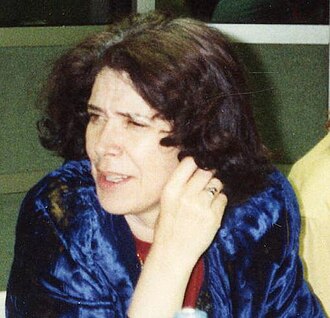
Assia Djebar
1936 — 2015 · Cherchell-born Algerian novelist and filmmaker; first Algerian elected to the Académie française in 2005; recipient of the 1996 Neustadt International Prize for Literature
Portrait: Wikimedia Commons, Creative Commons
Fatima-Zohra Imalayène was born on the thirtieth of June 1936 at Cherchell, on the Mediterranean coast of central Algeria sixty miles west of Algiers, the daughter of Tahar Imalayène — a teacher of French in the French colonial primary-school system — and Bahia Sahraoui, a homemaker of the urban Berber Algerian household. She was raised in the French-Algerian household of her father and educated at the French colonial Carnot lycée at Algiers.
She took the baccalauréat at the Lycée Bugeaud at Algiers in 1953 — among the first Algerian Muslim girls to take the baccalauréat at the Algerian colonial system — and was admitted in 1954 to the École normale supérieure de jeunes filles at Sèvres in suburban Paris as the first Muslim woman ever admitted. She left the École in 1956 in solidarity with the Algerian student strike of the National Liberation Front and completed the licence-ès-lettres at the University of Algiers in 1957 by correspondence.
She published in 1957 her first novel La Soif at the Paris house Julliard, under the pseudonym Assia Djebar — by which she was known thereafter — at twenty-one.
She took employment between 1958 and 1962 as a journalist at the El-Moudjahid, the National Liberation Front newspaper at Tunis, and on independence in 1962 returned to Algiers, where she was appointed professor of modern history at the University of Algiers from 1962 to 1965.
She interrupted the writing career between 1968 and 1980 to direct two feature films — La Nouba des femmes du Mont Chenoua (1978), awarded the FIPRESCI International Critics Prize at the 1979 Venice Film Festival, and La Zerda et les chants de l’oubli (1982).
She published across the following forty years a further thirteen novels — among them L’Amour, la fantasia (1985), Ombre sultane (1987), Loin de Médine (1991), Vaste est la prison (1995), La Femme sans sépulture (2002) — and several short-fiction collections.
She was awarded the 1996 Neustadt International Prize for Literature of the University of Oklahoma — the first Algerian recipient — and on the sixteenth of June 2005 she was elected to the Académie française to the seat formerly held by Georges Vedel, the first writer from the Maghreb in the Académie’s history.
She taught francophone literature at the New York University and the Louisiana State University between 1995 and 2014.
She died at Paris on the sixth of February 2015 of complications of cancer, at seventy-eight.
She is honored here as the first Maghrebi member of the Académie française.
Keep a life of your own
Every family has a life like this one. Begin with yours.
Sources
- Assia Djebar - Wikipedia (en.wikipedia.org)
- Assia Djebar - Filmmaker | Women Make Movies (www.wmm.com)
The house names where it read; it does not send you off the house's own pages.
The proof
This life is kept with a public fingerprint anyone can check.
bafkreif6htrq3apedwsgkul6kj3ppf3sg7dfvhpbg3o3rtxlberkvd7zta
Something here is wrong, or missing? Write to info@honoredancestors.com with the source; a person at the house reads every letter, and a correction is made only from a source.