Amílcar Cabral
1924 — 1973 · Founder of the PAIGC; agronomist and liberation theorist; assassinated nine months before independence
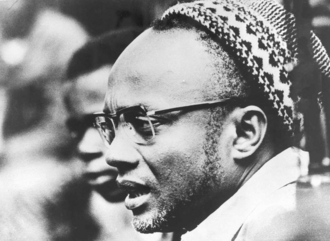
Portrait: Wikimedia Commons, Creative Commons
Amílcar Cabral was born in Bafatá, Portuguese Guinea, on the twelfth of September 1924, the son of Juvenal António Lopes da Costa Cabral, a Cape Verdean schoolteacher, and Iva Pinhel Évora, who kept the family by her needle and her shop. Schooled at the Liceu Gil Eanes in Mindelo, he completed his agronomy studies at the Higher Institute of Agronomy in Lisbon in 1950 and took his degree in 1952 — the only African in a graduating class of some two hundred and twenty — and his fieldwork conducting the colonial agricultural census brought him into intimate knowledge of every village in the country.
On the nineteenth of September 1956 he co-founded the African Party for the Independence of Guinea and Cape Verde (PAIGC), with Aristides Pereira, Luís Cabral, and three companions beside him. The armed struggle opened on the twenty-third of January 1963 with the attack on the barracks at Tite, and Cabral commanded it for the next ten years. By 1973 the PAIGC held roughly two-thirds of the territory of Guinea-Bissau — liberated zones so extensive that his movement would soon declare the nation's independence from within them.
His theoretical work was as consequential as his military command; he is widely regarded as one of the twentieth century's foremost liberation theorists, set often beside Frantz Fanon. His doctrine of "return to the source" — the proposition that African cultures, rooted in the rural mass, contained the political resources for sovereignty against any imported framework — was the operational counter to both colonial paternalism and orthodox Marxism. His writings — Revolution in Guinea (1969), National Liberation and Culture, The Weapon of Theory, and the posthumous collection Return to the Source (1973) — circulated globally and shaped liberation politics from Vietnam to Cuba.
He was assassinated on the twentieth of January 1973 outside his home in Conakry by disaffected members of his own party; the hand of the Portuguese secret police behind them is widely alleged, and historians still contest it. He was forty-eight — nine months before Guinea-Bissau's declaration of independence, which his comrades carried through with the country he had built ready to govern itself.
He is honored here as the agronomist whose return to the source defeated Portugal.
Keep a life of your own
Every family has a life like this one. Begin with yours.
Sources
- Amílcar Lopes Cabral | Biography, Revolutionary Leader, & Facts | Britannica (www.britannica.com)
- Amílcar Cabral - Wikipedia (en.wikipedia.org)
- Amilcar Cabral | Encyclopedia.com (www.encyclopedia.com)
- Amílcar Cabral — biographical note (Marxists Internet Archive) (www.marxists.org)
The house names where it read; it does not send you off the house's own pages.
The proof
This life is kept with a public fingerprint anyone can check.
bafkreidoww5r5ne7q7g55ae2v6xf2p7lfqckvq5gqzjwga4lwnnsrsetrm
Something here is wrong, or missing? Write to info@honoredancestors.com with the source; a person at the house reads every letter, and a correction is made only from a source.