
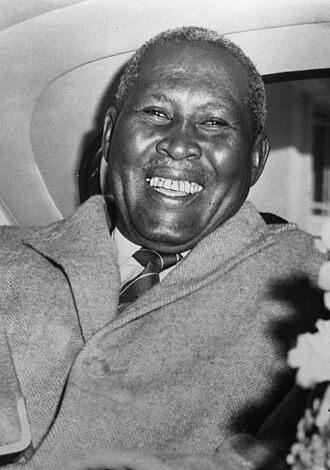
Albert Luthuli
1898 — 1967 · Zulu chief; ANC president 1952-67; first African to receive the Nobel Peace Prize (1960)
Portrait: Wikimedia Commons, Creative Commons
Albert John Mvumbi Luthuli was born around 1898 in the Solusi Mission in present-day Zimbabwe, the son of a Seventh-day Adventist evangelist and a Zulu mother of the Luthuli royal house. He was raised in Groutville, Natal — the mission settlement his family had founded — and took his teacher's training at Adams College, where he later returned as the first African on the faculty.
He was elected chief of the Abasemakholweni — the Christian Zulu community at Groutville — in 1936, holding the position for sixteen years. He joined the African National Congress in 1944 and rose to its national presidency in December 1952, succeeding James Moroka after the Defiance Campaign.
He led the ANC through its mass-mobilization decade of 1952 to 1960 — the decade that produced the Defiance Campaign, the Freedom Charter (1955), the Women's March (1956), the Treason Trial (1956 to 1961), and ultimately the Sharpeville massacre of the twenty-first of March 1960. He was repeatedly banned and restricted by the apartheid state, confined to his rural home district for the bulk of his presidency.
In 1960 he was awarded the Nobel Peace Prize — the first African of any nation, and the first person of any nationality from the African continent, to receive the Nobel in any category. The apartheid regime permitted him to travel to Oslo to accept the award in December 1961 under conditions of severe restriction.
He returned to confinement at his home in Groutville and remained banned for the rest of his life. The ANC under his presidency formally abandoned strict nonviolence in 1961 and founded Umkhonto we Sizwe; he supported the decision while remaining personally committed to nonviolent methods.
He died on the twenty-first of July 1967, having been struck by a freight train near his home — circumstances his family and the ANC have always maintained were suspicious.
He is honored here as the chief whose Nobel Peace Prize was the first African recognition of moral leadership at the global tier.
Keep a life of your own
Every family has a life like this one. Begin with yours.
Sources
- Lutuli, Albert J. — The Martin Luther King, Jr. Research and Education Institute, Stanford (kinginstitute.stanford.edu)
- Legacy of an African Hero – Chief Albert Luthuli and the Nobel Peace Prize — Luthuli Museum (luthulimuseum.org.za)
- Albert Luthuli — Wikipedia (en.wikipedia.org)
- Nobel Peace Prize 1960 — Albert Lutuli, Facts (NobelPrize.org) (www.nobelprize.org)
The house names where it read; it does not send you off the house's own pages.
The proof
This life is kept with a public fingerprint anyone can check.
bafkreifroyexi3x2afl4pc526edx6s7vf6u23tlk4gu4mm5qafaze6x7pq
Something here is wrong, or missing? Write to info@honoredancestors.com with the source; a person at the house reads every letter, and a correction is made only from a source.