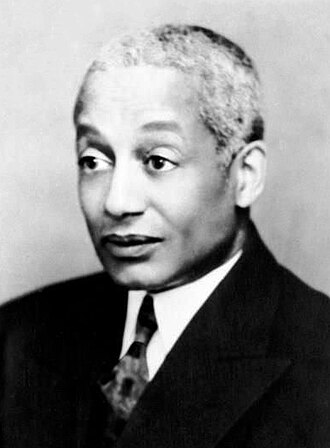
Alain Locke
1885 — 1954 · First African American Rhodes Scholar; philosopher and editor of the Harlem Renaissance
Portrait: Wikimedia Commons, Creative Commons
Alain LeRoy Locke was born in Philadelphia on the thirteenth of September, 1885, the only child of Pliny Ishmael Locke and Mary Hawkins Locke, both descended from established free Black families and both devoted to teaching. Raised in a home that prized learning and moral seriousness, he carried those inheritances into a life of the mind that would reshape American culture.
He took his undergraduate degrees at Harvard in 1907, elected to Phi Beta Kappa, and that same year became the first African American selected as a Rhodes Scholar. Turned away by several Oxford colleges on account of his race, he was admitted to Hertford College, where he read philosophy and the classics from 1907 to 1910 and helped found an African Union Society. He studied further at the University of Berlin before returning home, and in 1918 completed his doctorate in philosophy at Harvard with a dissertation on the theory of value.
From 1912 he taught at Howard University, where — save for a dismissal over his stand for equal faculty pay and his reinstatement in 1928 — he led the department of philosophy until his retirement in 1953. As guest editor of the 1925 Survey Graphic issue on Harlem and then of the landmark anthology The New Negro, he became the acknowledged interpreter and philosophical architect of the Harlem Renaissance, lifting up voices such as Langston Hughes and Zora Neale Hurston.
Locke died in New York City on the ninth of June, 1954. His vision of cultural pluralism and a proud, self-defining Black artistry endures. We honor Alain Locke, who opened doors sealed against him and held them open for generations to follow.
Keep a life of your own
Every family has a life like this one. Begin with yours.
Sources
- Alain LeRoy Locke - Wikipedia (en.wikipedia.org)
- Alain LeRoy Locke (1886-1954) - Hertford College, University of Oxford (www.hertford.ox.ac.uk)
- Alain Locke | Biography, Books, & Facts | Britannica (www.britannica.com)
The house names where it read; it does not send you off the house's own pages.
The proof
This life is kept with a public fingerprint anyone can check.
bafkreibjpdv4nor53plranmo7d2c5qjr4csalt6ptyr2lsozpnhotou54e
Something here is wrong, or missing? Write to info@honoredancestors.com with the source; a person at the house reads every letter, and a correction is made only from a source.