
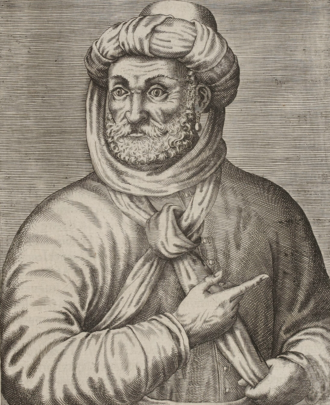
Ahmad al-Mansur
1549 — 1603 · Sa'adi sultan of Morocco; victor of the Three Kings at al-Kasr al-Kabir; conqueror of the Songhai Empire at the battle of Tondibi
Portrait: Wikimedia Commons, Creative Commons
Ahmad ibn Muhammad — known by his regnal name al-Mansur, the Victorious, and to the European chancelleries as Mulay Ahmad — was born in 1549 at Fez, the son of Sultan Muhammad al-Shaykh of the Sa'adi dynasty of southern Morocco. The Sa'adis traced their descent from the Prophet through the line of Hasan ibn Ali. He spent the seventeen years of his elder brothers' reigns at the Ottoman court of Algiers and at Istanbul, returning to Morocco only in 1576.
His accession came on the field of al-Kasr al-Kabir — the Battle of the Three Kings — on the fourth of August 1578. The Portuguese king Sebastian I had invaded northern Morocco at the head of a coalition with Ahmad's deposed nephew Muhammad al-Mutawakkil; in a single day's fighting Sebastian was killed, Muhammad al-Mutawakkil was drowned, the reigning sultan Abd al-Malik — Ahmad's brother — died of illness in the field, and the Portuguese army of twenty thousand was annihilated. Ahmad accepted the throne on the evening of the victory. Portugal, deprived of its young king and its army at one stroke, would within two years pass under the Iberian Union of Philip II of Spain.
Across his twenty-five-year reign al-Mansur made Morocco a major Mediterranean power. He reformed the army, built the El Badi palace at Marrakesh, opened diplomatic relations with Elizabeth I and exchanged seven embassies with England between 1585 and 1601. In 1591, in the most consequential single act of his reign, he dispatched south across the Sahara an army of four thousand musketeers under the Spanish renegade pasha Judar; the expedition crossed the desert in twenty weeks and at the battle of Tondibi defeated the much larger army of the Askia Ishaq II of Songhai. The victory destroyed the Songhai Empire and brought Timbuktu, Gao and Jenne under Sa'adi tributary administration for the following half-century.
Al-Mansur died of plague at Fez on the twenty-fifth of August 1603, at fifty-four.
He is honored here as the conqueror of Tondibi and the victor of the Three Kings.
Keep a life of your own
Every family has a life like this one. Begin with yours.
Sources
- Ahmad al-Mansur - Wikipedia (en.wikipedia.org)
- Essay: Ahmad al-Mansur (1549-1603) Renaissance Diplomacy Moroccan Style | Parallel Narratives (parallelnarratives.com)
The house names where it read; it does not send you off the house's own pages.
The proof
This life is kept with a public fingerprint anyone can check.
bafkreianrk67rpsb6w53zz7dfrsnijqqzqxprxnu5wvxpjlvhd25nsmnxa
Something here is wrong, or missing? Write to info@honoredancestors.com with the source; a person at the house reads every letter, and a correction is made only from a source.