
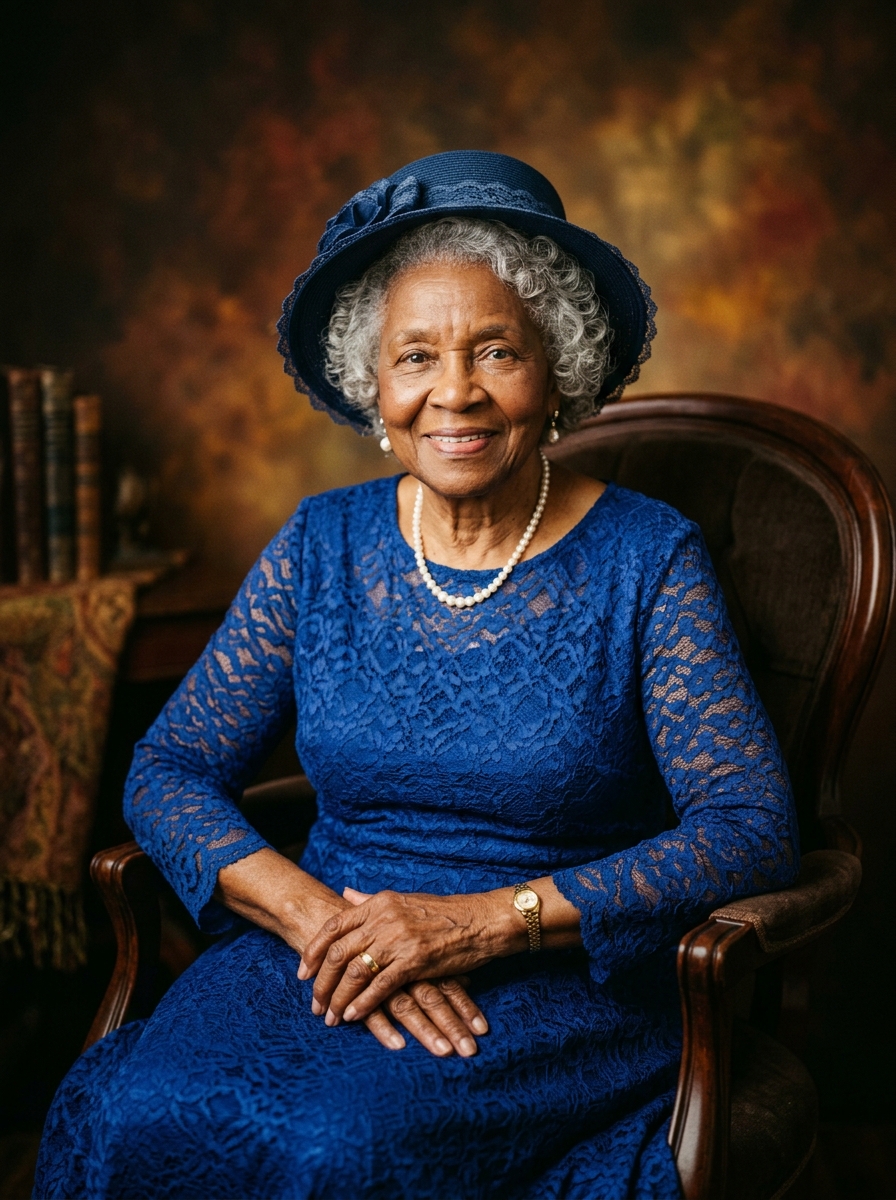
Rosalee Mae Johnson — Honored Ancestor | honoredancestors.com
A Mississippi-born seamstress, church mother, and family historian who taught three generations how to keep a name alive.
Rosalee Mae Johnson was born in 1922 in a small house outside Greenwood, Mississippi, the second of seven children. Her father worked the cotton fields. Her mother kept the house, the children, and a small Sunday-morning choir at the AME church down the road. Rosalee learned to sew before she learned her multiplication tables, and she was proud of that.
She married young, lost her first husband to the war, and made her way to Chicago in 1947 with a single suitcase and a butter-yellow dress she had cut and stitched herself on her mother's kitchen table. In Chicago she worked as a seamstress for almost forty years — for a Loop tailor, for a wedding-dress shop on the West Side, and finally out of the front room of her own apartment, where the sewing machine sat under a framed picture of Dr. King.
What people remember most about Rosalee was not the sewing. It was the talking. She kept the names. She knew which cousin married whose nephew, who had moved up from Alabama and who had stayed, who needed a meal that week, who was proud and who was struggling. At every family gathering she would hold court at the dining-room table, naming aunts and uncles three generations back and the towns they came from, until the children stopped being bored and started writing it down.
She read her Bible every morning and the Chicago Defender every evening. She raised four children, helped raise eleven grandchildren, and was a "second grandmother" to half the block. She voted in every election from 1948 forward and made her grandchildren walk with her to the polls so, as she put it, "they would know how it was supposed to feel."
She died in 2014, at ninety-one, in the same apartment she had lived in for fifty-two years. The funeral filled the church and the basement and the sidewalk. Her sewing machine still sits in her oldest daughter's living room, with the butter-yellow dress folded on top.
Rosalee did not write a book. She did not run for office. She did not invent anything anyone has heard of. She kept names, fed people, made beautiful things by hand, and taught a family how to remember itself. That is a life worth honoring, and that is exactly the kind of life this archive exists to keep.
Submitted with honor.
⚙ Permanence proof
This entry is pinned to the InterPlanetary File System (IPFS) by our own node so that a copy survives independent of any single web host. Anyone with the content identifier below can fetch a verifiable snapshot from any public IPFS gateway — now and decades from now.
To verify independently, paste the CID into any public IPFS gateway (dweb.link, ipfs.io, cf-ipfs.com).
Add to the record
If you knew this person, or know of them —
our editorial team welcomes additions. A fact we missed, an anecdote that belongs in the record, a correction. Each contribution is reviewed by hand and folded into the memorial with attribution. The IPFS record is re-pinned with the additions; nothing is overwritten silently.
Placed in the archive by the Honored Ancestors editorial team.