
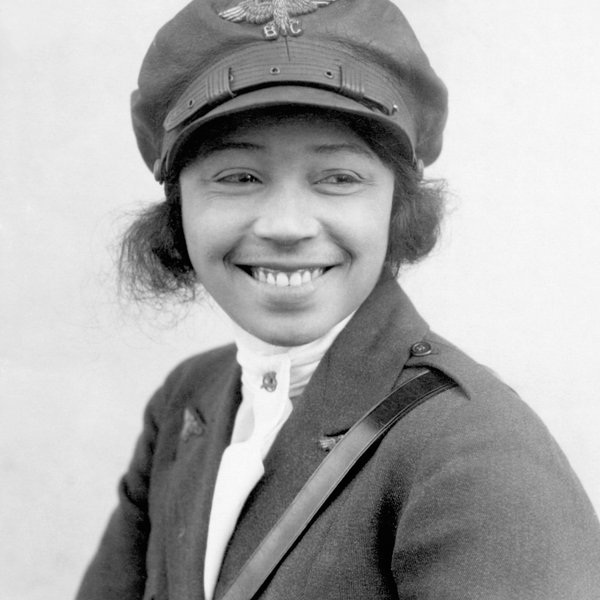
Bessie Coleman
A Texas sharecropper's daughter who taught herself French, sailed to Paris, and became the first Black American woman with an international pilot's license.
Bessie Coleman was born in 1892 in Atlanta, Texas, the tenth of thirteen children of two Texas sharecroppers, one Black, one Cherokee. She walked four miles each way to a one-room schoolhouse for Black children. She read everything she could find. She finished the eighth grade — which was the highest grade her county let her finish — and continued to read on her own, every night, by lamplight, until her eyes ached.
At twenty-three she moved to Chicago to live with her brothers, who had returned from France after the First World War and could not stop talking about the women they had seen flying airplanes over Paris. American flight schools refused to admit her. She was Black. She was a woman. There was no school in the United States that would teach her to fly.
She taught herself French, in night classes, while working as a manicurist in a barbershop on the South Side of Chicago. In 1920 she sailed for France and enrolled at the Caudron Brothers School of Aviation. On June 15, 1921, she earned her pilot's license from the Fédération Aéronautique Internationale — the first Black American, and the first Native American woman, ever to receive an international pilot's license.
She returned to a country that would still not let her use its airfields. So she barnstormed. She flew at fairs. She flew at carnivals. She executed loops, figure-eights, and a maneuver she had refined herself. Newspapers called her Queen Bess. She filled crowds of thousands.
She refused — every time — to perform at any airfield that would not admit Black spectators. In 1922 she flew at an air show in Houston where the organizers had segregated the entrances. She made them tear down the rope barrier or she would not fly. They tore it down.
She wanted to open a flight school for Black aviators. She saved every dollar. She spoke at Black churches and lodges and civic organizations across the country, raising money one fifty-cent ticket at a time. She told audiences she did not believe she would live to see the school open. She wanted them to know she was building it for whoever came next.
On April 30, 1926, she was in Jacksonville, Florida, preparing for an air show. She was riding in the back seat of her Curtiss JN-4, with her mechanic at the controls, when the plane banked unexpectedly and threw her out at three thousand feet. A wrench had been left loose in the controls. She was thirty-four.
Five thousand people attended her viewing in Orlando. Ten thousand attended her funeral in Chicago. Ida B. Wells delivered the eulogy.
She did not live to see the flight school open. Five years after her death, William J. Powell — who had been one of her audience members — opened the Bessie Coleman Aero Club in Los Angeles. Among its students was a generation of Black pilots, including the men who would become the Tuskegee Airmen.
Bessie Coleman flew because no one would let her. Then she made flying possible for everyone who came after her. She wanted them to know she had built it for them.
Submitted with honor.
⚙ Permanence proof
This entry is pinned to the InterPlanetary File System (IPFS) by our own node so that a copy survives independent of any single web host. Anyone with the content identifier below can fetch a verifiable snapshot from any public IPFS gateway — now and decades from now.
To verify independently, paste the CID into any public IPFS gateway (dweb.link, ipfs.io, cf-ipfs.com).
Add to the record
If you knew this person, or know of them —
our editorial team welcomes additions. A fact we missed, an anecdote that belongs in the record, a correction. Each contribution is reviewed by hand and folded into the memorial with attribution. The IPFS record is re-pinned with the additions; nothing is overwritten silently.
Placed in the archive by the Honored Ancestors editorial team.