
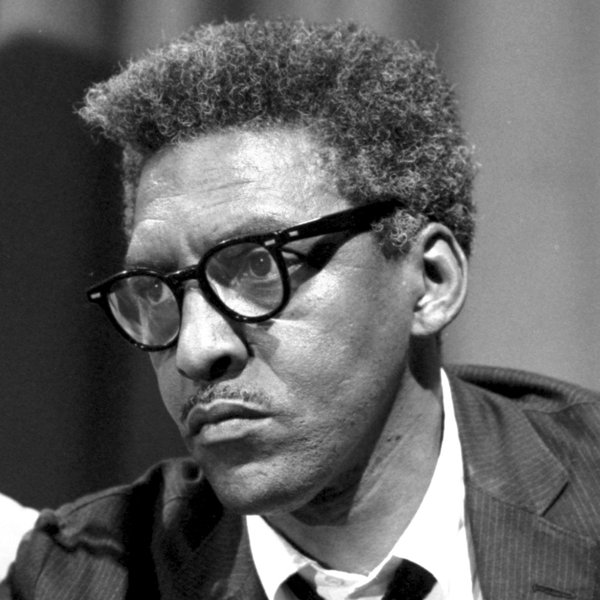
Bayard Rustin
The Pennsylvania-born organizer who taught Martin Luther King the discipline of nonviolence — and built the day on which I Have a Dream was spoken.
Bayard Rustin was born in 1912 in West Chester, Pennsylvania, raised by his Quaker grandparents in a household that took the doctrine of nonviolence as seriously as any oath. He was singing in church choirs at six, organizing his classmates against segregated establishments at fifteen, and arrested for the first time at seventeen for refusing to move to the back of a bus in Tennessee.
He spent twenty-eight months in federal prison during the Second World War as a conscientious objector. He emerged and went directly to the Fellowship of Reconciliation, where he co-founded the Congress of Racial Equality in 1942 and led the first Freedom Ride in 1947 — fourteen years before the second one was named that.
In 1956 he traveled to Montgomery, Alabama, to teach the principles of Gandhian nonviolence to a young Baptist minister named Martin Luther King Jr., who was leading his first boycott. King had armed guards at his house. Rustin spent two weeks inside that house, talking. By the time he left, the guards were gone.
He was the chief organizer of the 1963 March on Washington for Jobs and Freedom. He had eight weeks to prepare. He produced 250,000 lunches, eighty-three buses from the Bronx alone, port-a-potties, water stations, sound systems, marshals, and the stage on which King delivered I Have a Dream. He stood off-camera the entire day.
He stood off-camera because he was openly gay in 1963, and the movement's leadership feared that the FBI's file on him — which J. Edgar Hoover had been quietly building for two decades — would be weaponized against the day. He understood the calculation. He organized anyway.
The FBI had photographs. The FBI had wiretaps. The FBI had a contempt that does not die with its director. Rustin spent the rest of his life advising every major civil rights movement of the 1960s and 70s — from the SCLC to the AFL-CIO's A. Philip Randolph Institute — almost always from the second row of the photograph, almost always uncredited.
He came to gay liberation work later in life, joining the cause publicly in the 1980s when he was already in his seventies. He testified for New York's Gay Rights Bill in 1986. He was, by then, one of the elder statesmen of the modern American movement — and almost no one outside organizing circles knew his name.
He died in 1987, in New York, of a perforated appendix. He was seventy-five. His partner, Walter Naegle, kept his archive. His name was added to civil rights memorials decades after his death.
Bayard Rustin made the movement work. He made it possible for King to stand at the microphone in 1963. He did not need credit for this. The work was the credit. He kept the work.
Submitted with honor.
⚙ Permanence proof
This entry is pinned to the InterPlanetary File System (IPFS) by our own node so that a copy survives independent of any single web host. Anyone with the content identifier below can fetch a verifiable snapshot from any public IPFS gateway — now and decades from now.
To verify independently, paste the CID into any public IPFS gateway (dweb.link, ipfs.io, cf-ipfs.com).
Add to the record
If you knew this person, or know of them —
our editorial team welcomes additions. A fact we missed, an anecdote that belongs in the record, a correction. Each contribution is reviewed by hand and folded into the memorial with attribution. The IPFS record is re-pinned with the additions; nothing is overwritten silently.
Placed in the archive by the Honored Ancestors editorial team.